
Before a hole could pierce open a parallel dimension, unleashing murderous creatures like a Demogorgon into the placid existence of Hawkins, Ind., there needed to be another invasion.
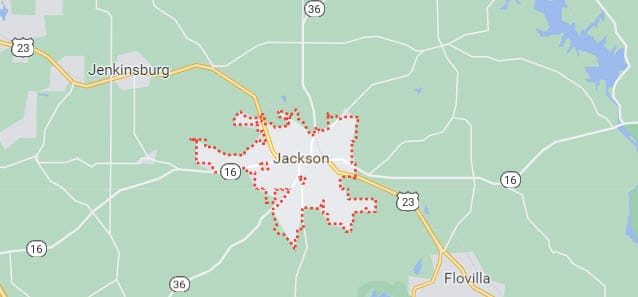
Hawkins, the fictional home of “Stranger Things,” had to take over the small town in Georgia where the hit Netflix show has been set since it debuted in 2016.
The old county courthouse in the center of Jackson, Ga., was turned into the Hawkins Library. An empty storefront became Melvald’s General Store. On the other side of the town square, a marquee was added to the front of a restaurant, transforming it into Hawkins’s movie theater.
But lately, Jackson has just been Jackson. “Stranger Things” retreated, along with most of the other movies and television shows filmed in Georgia, as the writers’ strike that began in May and the actors’ strike that followed in July reached far beyond Hollywood. The writers reached a tentative deal with studios in late September, and a ratification vote is underway. But actors are still negotiating with entertainment companies, keeping most TV and film production shut down.
As some of the nation’s most generous film tax credits have nudged movie and television studios to invest heavily in Georgia over the last 15 years, a number of cities and towns have tried to get a piece of the business. But the state’s embrace of the film industry has sometimes awkwardly collided with the conservative politics of its Republican leaders, who generally believe that resisting organized labor is a key to a welcoming business climate.
The economic pain inflicted by the work stoppages has prompted some elected officials, including the state’s labor commissioner, to reconsider Georgia’s relationship with the entertainment industry and the incentives that lured it in.
“I think those on strike better think long and hard about whether they think Georgia is a place where those incentives should stay in place,” the commissioner, Bruce Thompson, said in an interview before the Writers Guild of America reached its tentative deal.
But in places like Butts County, home to Jackson, some local officials have been more loath to criticize the strikes.
Michael Brewer, whose job as deputy county manager includes serving as a liaison to the film and television industry, acknowledged the disruption, particularly for consumers. “But I’m also trying to see it from the industry point of view,” he said.
“With inflation, with cost changes, the value of a dollar they made is not the same that it was,” Mr. Brewer added. “A lot of things have changed over the last few years. They have to make sure their rights are protected.”
The climate in Georgia, including its status as a right-to-work state where workers cannot be required to join a union as a condition of employment, has made organizing a challenge and left the writers and actors guilds with a limited footprint. The Writers Guild, which represents more than 11,000 screenwriters, has only a few dozen members in the state.
But many nonunion workers in Georgia’s film industry have expressed solidarity with their striking peers, whose concerns included decreased pay in the streaming era and the threat posed by artificial intelligence, even as they have struggled to make ends meet in recent months. The state typically has dozens of movies and television shows in production, but in recent months, filming has been limited mostly to reality series, like “Hoarders” and “Love & Hip-Hop Atlanta.”
“It’s kind of hard not to be salty about it, but I understand — the strikes needed to happen,” said Liz Bowman, who was a special effects artist for “Stranger Things” before the strikes began and has since been giving tours of locations from the show in Jackson. “I love the film industry, but I feel like sometimes you get these big studios and they forget that they have real people working for them.”
Read the Full Story at The New York Times