
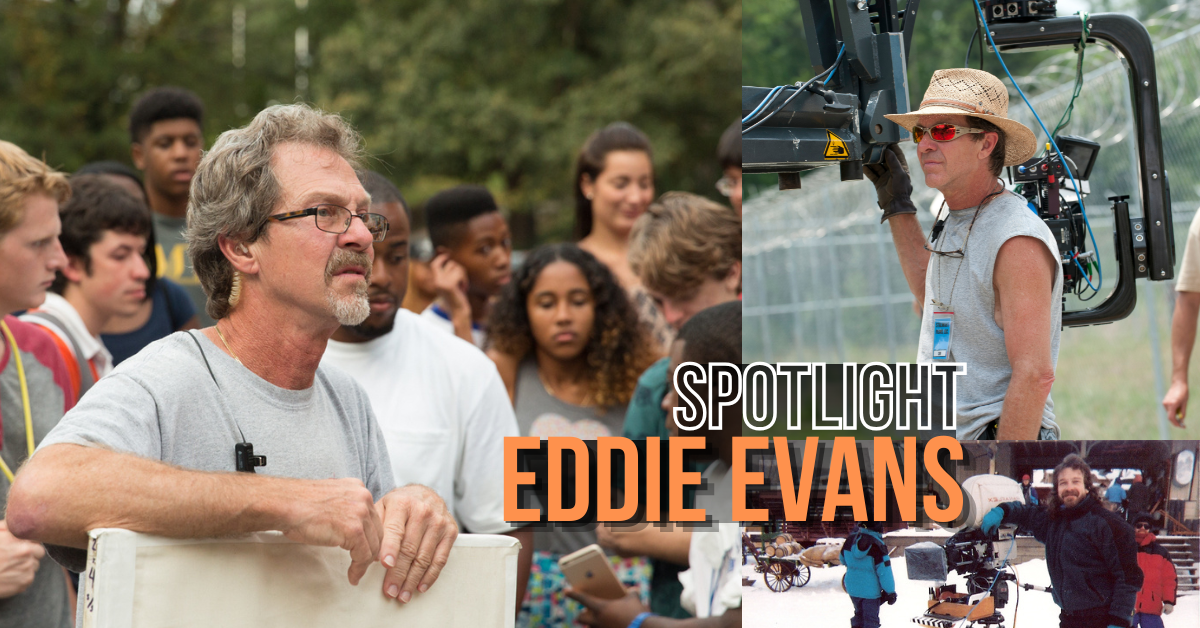
Athens-born and Georgia-raised, Eddie Evans set his sights on the film industry long before it flourished in his home state. In the late 1970s, he did not wait for an invitation. He opened the Yellow Pages. Every two weeks for six months, he called every film producer listed in Atlanta. There weren’t many. But he kept calling until someone finally said yes.
That led to a job sweeping floors and cleaning equipment at Atlanta Film Equipment Rentals. Unglamorous work, but it was proximity to the industry. It gave him access to cameras, lights and, more importantly, the technicians who used them. For Evans, it was never meant to be a permanent stop. It was opportunity.
“I knew I needed to make a living in the film business,” he said. “I couldn’t just wait for someone to call me. So, I made sure they knew who I was.”
Evans’ path into film wasn’t linear. As a student at Georgia State University, he wasn’t especially drawn to academics, with one exception. Photography captured his attention. He spent extra hours in the lab, constructing visual stories through a sequence of images. One professor noticed and asked whether he’d considered working in film.
He hadn’t, but he grew up fascinated by movies. He assumed films simply appeared from some distant creative class. Realizing working technicians built them changed everything.
In 1979, he landed his first feature film as a grip on “Wise Blood,” directed by John Huston. By then he had gone freelance, taking whatever jobs he could find, from commercials to industrial shoots. Like many early crew members in Georgia, he built his career when the local industry was still finding its footing.
“It’s unpredictable,” Evans said. “There were years when you went from one job to the next, and there were years when you had to budget carefully and use every other skill you had.”
Evans leaned on carpentry and physical labor to bridge slower seasons. On set, he learned quickly that versatility was not optional. Schedules shift. Scenes change. Weather intervenes. Directors rethink entire sequences. The ability to adapt became both his professional edge and his personal philosophy.
“You can’t get locked in,” he said. “You have to adjust on your feet. That’s true on set, and it’s true in life.”
An early on-set accident reinforced that lesson. While working as a gaffer on a commercial shoot, Evans suffered a serious electrical mishap that sent him to the hospital for more than a week. He recovered, but the experience clarified his path. Grip work, with its blend of engineering and hands on construction, felt natural. It also offered steadier employment as he and his wife raised two children.
Over the next four decades, Evans became part of the generation that transformed Georgia’s film industry from an afterthought to a national force. When he began, crews from Atlanta were often labeled “local,” which implied secondary status to Los Angeles or New York crews. Within a few years, Georgia technicians were no longer just supporting players. They led departments and were requested by name.
“It was a point of pride,” Evans said. “We went from being treated like the red-headed stepchild to being asked to come work all over the country.”
His résumé reflects that evolution. Evans worked on “The Crucible” alongside Daniel Day Lewis and Winona Ryder, an experience he reflects on with gratitude. He contributed to “The Blind Side” starring Sandra Bullock and “The Accountant” with Ben Affleck. He was present for multiple Academy Award-nominated performances, moments he still speaks humbly about.
On “The Blind Side,” he recalls watching Sandra Bullock adjust her performance subtly from take to take, offering different emotional textures for the director to choose from. Closely observing that level of professionalism left a lasting impression.
“It’s an honor just to be in the room,” he said. “To watch someone work at that level.”
After decades of freelancing, long hours and unpredictable schedules, Evans was drawn back to an early aspiration. Before film took over his life, he once considered becoming an English teacher. That calling resurfaced when he joined the Georgia Film Academy as an instructor.
At GFA, Evans now teaches students not just how to rig equipment or read a set, but also how to thrive in the industry. He emphasizes persistence, listening carefully to repeated advice and never feeling above any position that keeps you learning and working. When he needed work, he called former colleagues. When he wanted to teach, he reached out directly and asked for the opportunity.
“I always believed I could do what was required,” he said. “That confidence helped me.”
He encourages students to remember every contact they make and to maintain those relationships. The industry may fluctuate, but relationships endure.
Looking back, Evans admits there are projects he wishes he handled differently and opportunities he might have approached another way. But appreciation tempers those reflections. He built a life doing work he enjoyed. He witnessed the rise of Georgia as a production hub. And now, he loves passing that knowledge to the next generation.
From cold calls in the Yellow Pages to feature films with A-list talent, Evans’ career is a testament to adaptability, persistence and the quiet pride of building something lasting, one job at a time.