
By Carolyn Badaracco
Data centers are the internet’s physical home—massive structures that store, process, and distribute digital data and enable services like streaming, cloud computing, and AI. They house the servers and storage devices that power the global digital economy.
According to McKinsey and Company, a 10-decades-running private New York-based international management consulting firm whose partnerships include companies such as Google Cloud, Microsoft, NVIDIA, Salesforce, and others, demand for data centers is predicted to triple by 2030.
At present, some 10,500 data centers are operating around the world in 174 countries—40% of them in the U.S., including in Alpharetta, Douglasville and Norcross, Georgia.
A Jan. 10, 2026 report from cybersecurity education and career development site Programs.com called “Measuring the Data Center Boom: Facts and Statistics” reveals a telling statistic: between now and 2030, companies around the globe are expected to invest $7 trillion in building and upgrading data centers.
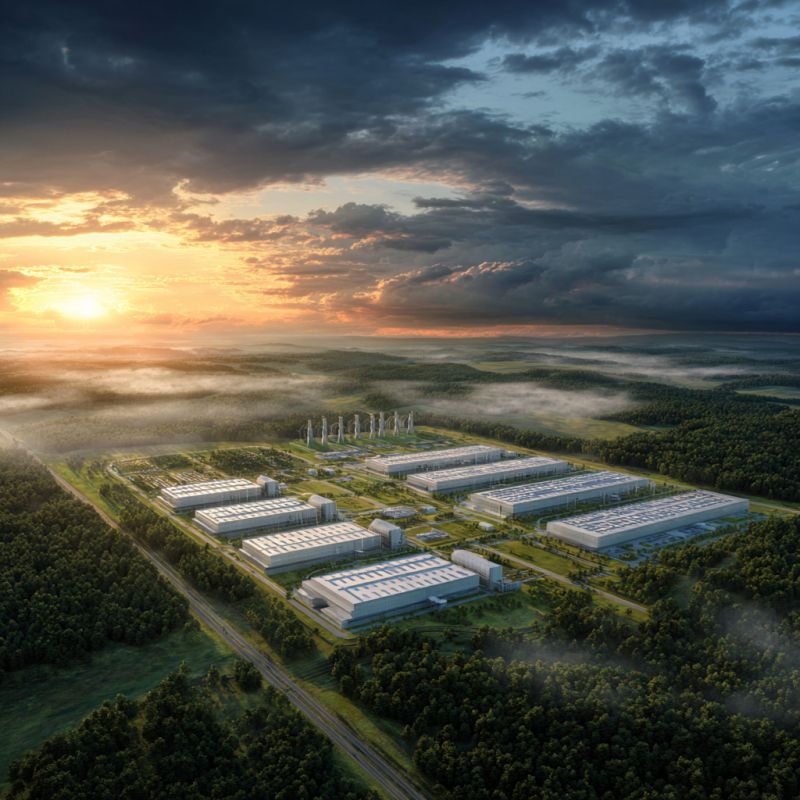
Georgia is currently experiencing even more growth on the data center front with the new Forsyth Technology Campus in Forsyth. It sits in Monroe County, west of I-75 and 25 miles north of Macon. The 1,632-acre, $21-billion development is expected to cover 12 million square feet of buildings—far eclipsing the footprint of Hartsfield-Jackson Atlanta International Airport’s terminals.
According to a press release at construction project tracker BLDUP.com, the Forsyth Technology Campus is projected to generate over $220 million in annual local tax revenue and to create up to 700 permanent jobs when fully built, which is projected to be 2037.
John E. Hall Jr., a founding partner of Atlanta-based litigation firm Hall Booth Smith P.C. says the firm is working on cases surrounding data centers in Georgia. From his real-world perspective beyond the stats, the numbers and types of jobs that data centers can create for the state are staggering.
“Employment growth would be substantial in the direct management, operation, and servicing of these data centers, and increased tax bases,” Hall said. “The centers will also create a side-industry of supporting services that’s going to increase employment. Construction jobs, for example, would increase.”
Indeed, big-four accounting firm PwC reported to Programs.com for its aforementioned report that “for every data center job, six indirect jobs are created.”
From another angle, an ace in the hole for Georgia when it comes to being selected as the site of new data centers is resources—namely power and water, which data centers gobble down in copious amounts.
“Georgia is one of the fast-growing areas in the country on these because of our infrastructure, with Georgia Power and our communications sources. There’s also a great deal of legislation out there to try to encourage these projects and give tax status,” Hall said. “And then they’re trying to figure out the water and the power usage, and also the quality-of-life aspects for county people. That is going to be an issue that comes out of it.”
Water requirements and usage, as Hall mentions, are especially challenging aspects of data center operation. As much as continuous power is critical, so is the uninterrupted churn of water for cooling. (In North Georgia, existing data centers are reported to draw from Lake Lanier through local municipal water systems with permits to withdraw water.)
Beyond the obvious challenges lie rich opportunities in the making.
Just as all technology scales down as it becomes more sophisticated, like smartphones and ultra-thin media displays, Hall foresees diminutive data centers springing up like Georgia wildflowers in the future.
“We’re involved in the development of community data centers that are on a much smaller scale,” he said. “If you can imagine the advent of computers in the ‘80s and ‘90s, people were really debating whether or not everything was going to be these huge mainframes in every building and every office. And what happened was they developed laptops.”
Hall continued, “I think that’s what’s ultimately going to happen with data centers. Companies like Oracle are looking to put a thousand data centers in these small areas that don’t require the increase in power or cooling because of their size. And they can fit very well into community space that’s already available, or relatively contained community space.”
What about AI—how is it changing the face of future data centers, and how might that impact Georgia?
“AI is going to maximize the need and use for data centers,” Hall said. “Most companies are going to have their own generative AI systems, and that’s going to require computing power to process and [deliver]. Having these community centers is going to increase the stability of that system, cut back the risk of failure, and provide more access for computing power.”
In any data center, large or small, security is another principal issue to consider. If a center were to be hacked or go down due to a natural disaster, for instance, a world that relies on digital data and its distribution could risk faltering.
According to Hall, “That’s one of the reasons to look at these community data centers, because they have the power to spread that risk over a far, far greater level.”