
by Michael Lewis
We are in the midst of March Madness, an essential fixture of the American sports calendar and arguably the greatest tournament in American sports. This year, March Madness is even more eventful because it is a significant indicator of where sports fandom is headed.
The tournament is tailor-made for fan engagement. It features a dramatic selection process, a massively inclusive field of 68, and a ruthless single elimination structure. Narratives are built in real time as Cinderellas battle blue bloods in an avalanche of first round games in mid-March that lead to the Final Four in early April. It’s also a tournament built for fans, as it provides a three week gambling opportunity that requires little expertise but generates enormous engagement. As a magnet for public attention, it’s nearly perfect.
Most of that describes the Men’s tournament. Yet, over the past few years the Women’s tournament has fully shared the March Madness spotlight with massive viewership numbers and major stars.
The 2026 Women’s NCAA Tournament will provide a critical temperature check on perhaps the most fascinating current fandom story: the rise of women’s basketball. The women’s game, both college and pro, has been enjoying the cultural spotlight for several years, much of it traceable back to this tournament. But it’s even more than a basketball story. Women’s college basketball has become the clearest laboratory we have for considering the future of women’s sports.
The Temperature Check
The championship game viewership is the cleanest single data point we have, and it tracks the arc of the women’s tournament better than anything else. One game, same stakes every year, no noise from scheduling or television network decisions that complicate most other viewership comparisons.
The Figure shows the title game viewership for the Men’s and Women’s tourneys from 2014 to 2025.
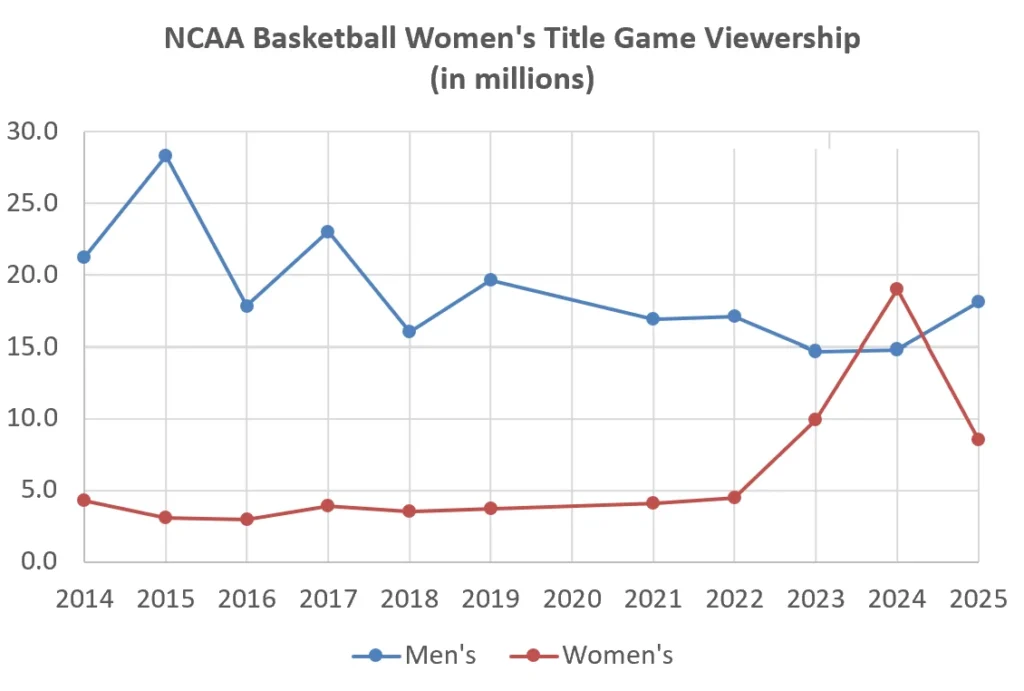
The women’s championship game viewership shows noisy data with a small upward trend from 2014 to 2022, then a massive peak in 2023 and 2024, followed by a significant decline in 2025. But even with the drop from 19 million to 8.5 million, last year’s viewership was nearly 90% higher than 2022. That’s data worth exploring.
Predicting either the men’s or women’s viewership is a challenge. Like all sports, it’s about brands and stars. On the men’s side, Duke, North Carolina, Kentucky, and Kansas are the top brands. On the women’s side, it’s Connecticut, South Carolina, and LSU. But the last three years put us in uncharted territory. Clark especially, but also Reese and Bueckers, became media stars who attracted interest well beyond the established women’s basketball fan base.
The question is whether these stars represented a cultural moment or whether we are experiencing a fundamental shift in women’s basketball fandom.
Why the Tournament is the Test Case
The Women’s NCAA Tournament is the test case because March Madness eliminates or mitigates many of the structural problems that have constrained the growth of women’s sports.
The lack of structural issues has allowed the Women’s NCAA Final Four to produce some of the strongest viewership numbers in women’s sports.
A comparison of March Madness viewership versus WNBA viewership makes the point. Last year’s WNBA Finals averaged about 1.5 million viewers, up 13% from 2024. But the 2025 WNBA Finals didn’t have Caitlin Clark. The May 2025 matchup between Clark’s Fever and Reese’s Sky was the most watched WNBA game of all time, averaging 2.7 million viewers. Iowa plus Clark versus LSU plus Reese in the 2024 Semi-Finals drew 12.3 million. A WNBA Finals with Clark would break records, but it would still be watched by a fraction of the audience that watched her in college.
This is what makes women’s college basketball the most telling data point. It has the fandom, branding, and marketing advantages that other women’s sports are still trying to build.
- Natural Fandom Women’s college basketball inherits something professional leagues spend decades trying to manufacture: natural fandom. College sports fandom is built in. A large part of the magic is the “we,” and we naturally root for the schools we attended. It’s a more intense form of identity than most professional sports because students and alumni aren’t just fans, they’re explicitly members of the institution. That connection doesn’t fade when you graduate. Collegiate fandom has been developing for over a century and is woven into both the campus and alumni experience. Think of it as the Olympics on a smaller scale, where we aren’t just rooting for a uniform but for a community we explicitly belong to, whether that’s the USA or UGA.
- Branding Women’s college basketball inherited something few women’s sports ever get: a powerful, established brand. The term “March Madness” traces back to Illinois high school basketball before Brent Musburger attached it to the men’s tournament in the 1980s, building one of sports’ most recognizable franchises over four decades. In 2022, following a gender equity review that identified significant disparities in marketing and resources, the women’s tournament gained the right to use that branding. Consider the analogy: imagine a women’s flag football league running its championship alongside the NFL with “Super Bowl” branding. Outside of tennis and international soccer, women’s sports almost never get this. The marketing infrastructure that makes a sports event culturally meaningful takes generations to build, and women’s leagues almost always have to start from scratch. Women’s college basketball doesn’t.
- Symbiotic Professional League The women’s college game has a uniquely symbiotic relationship with its professional league, one that runs in the opposite direction from every other sport. In men’s college basketball, the one-and-done era ended the multi-year arcs that built legends. Lew Alcindor, Larry Bird, Michael Jordan were players who spent three or four years with the same program and became icons of both college and professional basketball. That era is gone. Today’s men’s college stars are largely unknown until the second half of March. The women’s game is different. Players spend four years with their programs and transfers are far less common. The result is that Caitlin Clark, Angel Reese, and Paige Bueckers arrived in the WNBA as fully formed brands with their own fan bases. Angel Reese has 5.2 million Instagram followers. The Chicago Sky have 586 thousand. When the Fever obtained the rights to draft Caitlin Clark, they immediately sold out their home ticket inventory. The WNBA needs women’s college basketball far more than the reverse.
Predictions for the 2026 Tournament
The 2026 Women’s tournament will be revealing. The upsurge in interest over the last three years has been narrative and star driven. Caitlin Clark broke through in the 2023 Final Four and Angel Reese became her rival in the Finals. The 2023-2024 season was powered by their individual stardom and rivalry. In 2024-2025, the baton passed to Paige Bueckers. The next star up was JuJu Watkins from USC, but an ACL injury forced her out of the 2025-26 season. The player who broke through this season, especially via social media, is Audi Crooks from Iowa State, but her team didn’t survive the first weekend of the tourney.
TV viewership this year has been strong. ESPN reported a 33% year-over-year increase in women’s basketball programming. Notable highlights include 1 million viewers for the Iowa State-Iowa matchup featuring Crooks, and 1.7 million for South Carolina versus LSU. But a 33% increase coming off the Clark-Reese-Bueckers era is too striking to accept at face value. Are the comparisons apples-to-apples, or are network and time slot changes inflating the numbers?
Going into the tournament, the narratives seemed more focused on coaches than players. Geno Auriemma, Dawn Staley, and Kim Mulkey are perennial headliners. There were a handful of players with some notoriety: Crooks (Iowa State), Hannah Hidalgo (Notre Dame), Sarah Strong (UConn), Azzi Fudd (UConn), and Lauren Betts (UCLA). Great players, but they entered with far less national media hype than the headliners of the past three seasons.
As we approach the Final Four, the tournament has played out about as well as possible for fan interest. All the top seeds have survived, so UConn and South Carolina are still alive. Having the sport’s most storied brands, most decorated coaches, and several of this year’s highest profile stars bodes well for the final’s viewership.
My forecast: The Final Four has UConn and South Carolina on the same side of the bracket, so maybe the best case matchup in the finals is a UConn-UCLA matchup. If we get that matchup, I think we get a number in the 7 to 7.5 million range. A decline from last year but above the pre-Clark historical trend. A mixed piece of evidence.
But this isn’t really about prediction. It’s about this tournament and the title game as a key indicator of the state of women’s sports. Viewership above 8 million suggests the Clark-Reese-Bueckers era shifted the baseline upward. Below 5.5 million suggests the era was about a few compelling stars and didn’t produce a permanent boost. In between is a mixed bag, some sustained growth, some fading of a special moment. I think that’s where we are.
Authors Note: I have also published a companion piece to the current article on my Substack that discusses the discomfort and controversies that can occur with this kind of article. It’s a little insight into the challenge of analyzing cultural products that intertwine with fan identities.