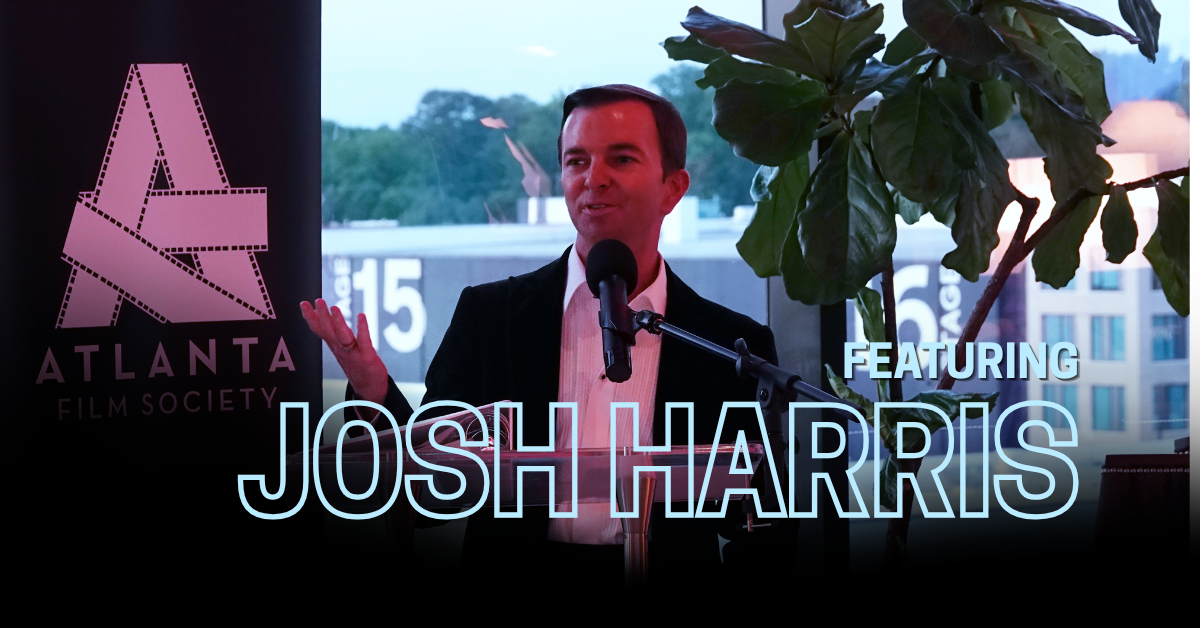
Atlanta-based film producer Joshua Harris has made feature films all over the world. “Bride Hard” (2025), “We Bury the Dead” (2024), “Goodrich” (2024) and “Coyotes” (2025) are just a few.
Simultaneously, he owns two film-critical companies in Georgia, Peachtree Media Partners and Gramercy Park Media. At both, he serves as president and managing partner. The former is a fund that provides financing solutions to the film industry. The latter a production company.
“At Peachtree Media, we lend against tax incentives, pre-sales, distribution agreements and unsold territory rights, which we call gap lending,” Harris describes.
“At Gramercy Park, producers come in and help package the film, develop the film, get the film made and across the finish line,” he says. “The two companies really complement each other.”
Home field advantage
Harris is deepening his efforts where he lives and breathes.
On May 5, 2026, Harris and team wrapped a horror movie shot in Atlanta, “In-Ground,” starring Alexandra Daddario and Kyle Gallner.
“I won’t give away the twist, but basically it’s a scary movie about when you dig up the backyard, and you’re digging up more than just an in-ground pool,” Harris says.
His work on “In-Ground” is exciting to him beyond its genre and storyline; equally satisfying is the fact that the production and four others from his companies were shot locally within the past six months.
“In terms of what we’re doing at both Gramercy and Peachtree, I’m probably most excited about shooting more domestically, and specifically in Georgia,” says Harris. “This is a complete turnaround with these two companies in the last 18 months, because we were shooting 90% of our movies overseas, and we’ve completely turned that ratio upside down.”
Along with the five films just mentioned, Harris and team have four more slated to go into production in the state before the end of the year.
At present, his companies are shooting 75% – 80% of its movies domestically. And this means two important things to him personally: he gets to be at home with his family more and he’s helping put Georgians to work.
“We are really doubling down on the Georgia strategy, putting crews to work in Atlanta and the surrounding areas and reinvesting in the community that we call home,” Harris states.
In terms of the family business, his teen daughter, actress and rising star Mila Harris, is also working a good deal more in her home state these days.
Along with appearing in a number of feature films outside her family’s home turf, two of them, “Mary” and “World-Breaker,” with Harris acting as producer, the pair is shooting another feature film in Atlanta this summer.
“I won’t give the title yet, but it’s a teen slasher film with a really fun storyline and a fun twist for audiences,” Harris says.
Championing independent film
As much as Harris is excited about shooting near (and with) his family and putting other Georgia residents to work in the process, he is encouraged by the positive momentum he’s seeing in the industry following its recent years of hardship.
And while this hardship was experienced everywhere, not just in Georgia, Harris is pleased to see the state turning a corner, navigating industry-wide changes and stepping out as a leader.
“Every big studio that left Atlanta went for better tax incentives and lower costs of doing business, which they’re right to do,” he contends. “That’s how it works. But let’s be clear, all of them haven’t left. They’re still shooting big films here: ‘Superman,’ for instance.”
And yet, the shakeup in the industry and the change in volume left a stark gap in Georgia’s workforce.
“All of those who support the film industry that moved here to Georgia from Los Angeles and other markets were left jobless and in distressed situations with their families that had planted roots here in Georgia,” Harris states.
And he emphasizes, “We saw this as an opportunity to step in, in the place of the studios.”
Essentially, Peachtree Media Partners and Gramercy Park Media are putting that gap to work.
As Harris describes, “We met with the Teamsters and some of the unions, and we said, ‘Look, we’re the fastest growing independent finance company in the world for film and television. We’ve got a slate of opportunities. We can shoot these domestically, in Georgia, and we can employ Georgians and put people back to work.’”
What Harris and his companies were asking for was guidance and assistance to make the plan work.
“Through that strategic partnership, we’ve been able to roll the dice, and we’re really testing the theory,” he notes. “It’s early yet. We have to give it time and a turn cycle to see [what happens now].”
In the process, Harris says the effort has provided a space for independent film to fill the gap where the studios left off.
“To me, the brightest spot of the whole thing is that the majority of our industry is centered around independent film,” he states.
He adds, “It’s not the studios. It’s really everybody else. And so if we can continue that and make Georgia the best place to do business as an independent filmmaker, that’s a win. A big win.”
A lucrative win, in fact, for the Peach State. Because 75% of the films people consume today through streaming, on their devices, or in the theater are independently made.
“So, we have to lean into independent filmmakers, and we have to put them to work, and we have to give them the resources they need to make the product,” Harris emphasizes,
Lifting up the local creative community
Another bonus of making independent films—or any film—in Georgia falls more on an intangible plane. And yet a felt plane that those who do business in the state readily acknowledge.
The creative community of filmmakers in Georgia is different, welcoming, energetic, alive with what people around the world know as Southern hospitality.
It’s an enviable position.
“We care about each other as Georgians, particularly in this industry,” Harris notes. “We have to look out for each other. The only people we can really count on are the tribe that we’re part of. And that is this film community.”
While the challenges of the industry have been tough, filmmakers remain there for one another in Georgia.
Harris states, “We have to lean in and help each other when we’re at our highest points and when we’re at our lowest points. Be there for your fellow tribesmen. Be there for the people that have been there for you, good, bad and indifferent. And double down and give back to the community that has supported you throughout your entire career.”
And he closes, “That’s what we’re doing. We’re putting our money where our mouth is, and we’re supporting the people who have been there with us since the beginning.”