
By Georgia Entertainment staff
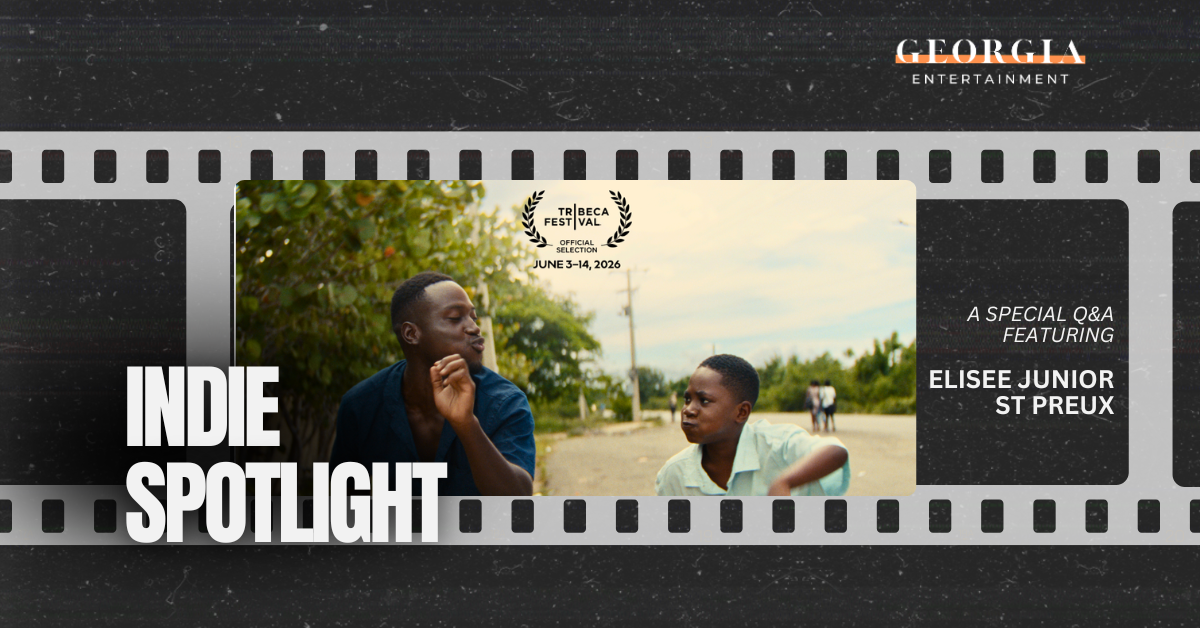
We sat down with Elisee Junior St. Preux to talk about “The Tropic Sun and His Eyes,” an official Tribeca Festival selection and the first mental health narrative film shot entirely on land in Haiti. The Atlanta-based filmmaker drew from personal loss to craft a story about estranged fathers and sons, and the generational trauma that keeps them apart.
Can you tell us a little about your film and what inspired the story?
St. Preux: “The Tropic Sun and His Eyes” is the first mental health narrative film shot entirely on land in Haiti. It follows a despondent young man who embarks on a journey to reconnect with his estranged father. Along the way, he meets a street kid who insists on joining the journey with him. As they interact with locals and hear their stories of joy and pain, it becomes more apparent that they must love out loud and break generational trauma together.
I lost my sibling to mental illness over a decade ago. Much like the lead character in this story, my sibling struggled to connect with our parents due to cultural, societal and generational differences. Eventually, they ran away and never came back. This film is crafted as a visual representation of what it might look and feel like if my sibling were to return home.
While this narrative is primarily from my perspective, other family members have their own viewpoints. I wanted to center this journey around mental health because I believe people don’t simply walk away from their families without a reason. There is often deep hurt involved, which can be traumatic and lead to further issues. As I typically focus on Black men in my stories, I flipped that inspiration on its head to explore the relationship between estranged fathers and sons.
You shot this film on location. How was the experience shooting in Haiti? As an Atlanta-based filmmaker, what support did you find in your community here?
St. Preux: Shooting in Haiti was the hardest thing I’ve ever done in my life. It is a very specific place and a very specific venture to shoot internationally. At the same time, it was an experience I will never forget. It changed the way I look at filmmaking, my artistry and, most importantly, my family.
My community here in Atlanta stood behind me every step of the way. I crowdfunded for this film four times, and every time I received support from people in Atlanta. They also consistently talked about the film to people in rooms that I am not in and championed the project.
What were the biggest challenges you faced while making this film, and how did you overcome them?
St. Preux: Production was treacherous. I attribute this to the lack of a filmmaking ecosystem in Okap, which is not the fault of the local people. We encountered various dangerous and health-related situations throughout our time there. Additionally, financial issues were a significant challenge.
The country experienced a tech outage as soon as we arrived, so we had to conduct all transactions in cash. Unfortunately, I hadn’t brought enough cash to last the two weeks of production. To solve this, I had to MoneyGram the exact amount I needed for each day’s shoot to my producer in Haiti the night before. He would then go to the bank in the morning to withdraw the equivalent amount in Gourde, and we would proceed with our filming.
We repeated this process every day.
“The Tropic Sun and His Eyes” is an official selection at the Tribeca Festival. What did the submission and acceptance process teach you about positioning your work for major festivals?
St. Preux: It taught me to be patient, but also be strategic. The main festival you want may not be the festival that is right for your film. I was especially touched by the acceptance message from Tribeca, which came as a personal email from the lead international programmer. It was the warmest message I’ve ever received regarding the film. It brings me great joy to know that Tribeca is championing this project in this manner. It feels like it was always destined to premiere with them.
What do you hope audiences take away from your film?
St. Preux: To this day, the vast majority of Haitian men believe that the primary role of the father is to provide financial support for the family and male dominance. But many times, the son just wants to be loved.
Haitian fathers never tell their sons “I love you,” and their sons never have the confidence to say it to them. I want fathers to take the time to understand their sons on an emotional level. I want fathers to work on their vulnerability so their sons can follow suit when they grow up.
The version of Haiti we explore in this film is a mixture of the one my people know and love, as well as the one we hope it to be. More vulnerable men, more attention to mental health and more safe spaces for families to call home. Haiti deserves a new narrative!
Can you share your approach to getting this film financed?
St. Preux: This project was funded through a combination of four crowdfunding campaigns, philanthropic support from nonprofits, a filmmaker grant and substantial out-of-pocket contributions from me. I secured a fiscal sponsor early in 2023 so that when people donate or support the film financially, it is tax-deductible. This is a game changer for indie filmmakers as it attracts more people to support.
Most of the larger support I received was through cold emailing like-minded organizations who shared the same mission as me. This is a longer approach, but worth it, as it gives me more creative freedom.
Are there any local businesses, organizations or individuals you’d like to shout out for their role in helping the film?
St. Preux: A HUGE shout-out to Warner Bros. OneFifty and New York Latino Film Festival for the grant, Behive Health, Haiti Bright Futures, The Coca-Cola Company, the Black Men’s Research Institute at Morehouse College and many others. They know who they are. I tell them how grateful I am all the time.
What advice would you give to filmmakers looking to make their own projects and tell their own stories?
St. Preux: If you are called to tell a story, and it feels risky, PLEASE do it. You’ll never stop thinking about it if you don’t. And that is probably the story you should be telling.
Looking ahead, how do you hope your film will impact audiences and contribute to the broader indie filmmaking landscape in Haiti, Georgia and internationally?
St. Preux: International audiences tend to have a more compassionate and realistic perspective on Haiti compared to Americans, so I aim for them to understand it fully and thoughtfully. I also hope that the Haitian diaspora in these countries feel acknowledged. Although this is a Haitian film, it is also meant for the diaspora. And there is a lot of the diaspora here in Georgia. We tend to be a little more under the table than the others, but I hope this film brings us all together.
 The Georgia Entertainment Indie Spotlight, sponsored by Universal Production Services at Assembly Studios, is a recurring feature dedicated to showcasing independent filmmakers with strong ties to Georgia. Through written Q&As, profiles, and other coverage, we aim to celebrate the creativity, resourcefulness, and impact of local filmmakers who are contributing to the state’s growing film ecosystem.