By Tara Duncan
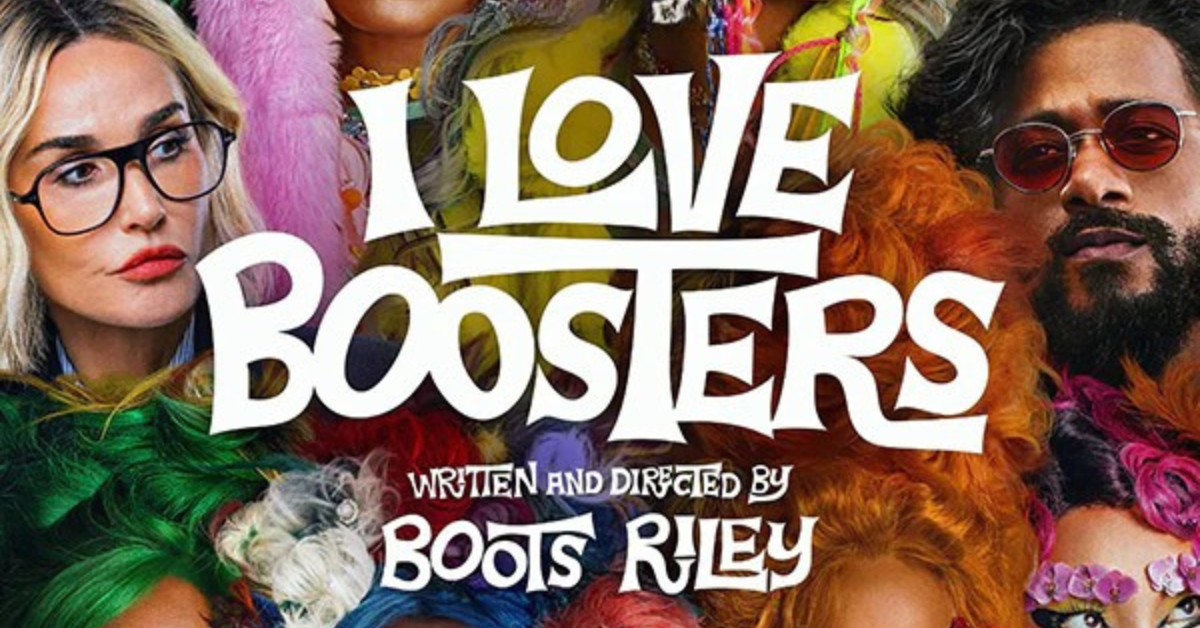
Boots Riley’s “I Love Boosters” never screened at the Cannes Film Festival, but the film’s marketing campaign drew repeated attention during an official financing forum there earlier this year, cited as a potential model for where independent film promotion may need to go.
The campaign drew praise for being grassroots, community-driven, deeply personal and inseparable from the film itself.
By the time “I Love Boosters” reached the Atlanta Film Festival 50th-anniversary celebration, it had already become a fixture in festival-circuit conversations. From SXSW to Atlanta and nearly every major stop in between, it frequently stood out as something worth studying.
For an industry looking to break through the crowded entertainment landscape without studio-sized budgets, Riley’s approach seemed like a blueprint. With a reported $20 million film, the marketing had to be both effective and inexpensive. Riley made it his personal mission to ensure people saw the movie, despite the lack of a large-scale advertising budget. So much that one user, @kashishshah99, posted “Boots Riley is at my house, holding me at gunpoint and asking to see I Love Boosters,” which Riley reposted, saying “There’s a path we can take and all be laughing about this tomorrow.”
He flooded social media with calls for audiences to see the film, to bring friends, post reactions and actively share in its success. He responded to so many moviegoers and promoted the film so often that he even had to temporarily verify his X account to remove post restrictions.
In an era of fragmented attention across streaming platforms, social feeds and theatrical releases, getting people to discover a movie can be as difficult as making one. Riley was competing not just with other independent films but with blockbuster franchise releases whose marketing budgets far exceed those of independent productions.
And that’s why Riley’s campaign became such a topic of conversation. The question wasn’t simply how he marketed the film, but also why people cared enough to help market it for him.
Riley’s social media push, festival Q&As and college campus tour alone would not have been enough to rise above blockbuster competition. He also needed to create something people wanted to see. To make his uniquely weird work with a largely star-studded cast on such a small budget, it had to be a passion project built on total trust in his vision. So, much of his success first depended on the talent he chose.
“I’m always looking for actors who are really just trying to work from a place of experiencing the feeling themselves, not just figuring out how to look like they’re experiencing,” Riley said at CinemaCon. “That makes it more real, that makes it more grounded. Then, if I have grounded performances by the actors, I can do all kinds of stuff. I can have the set turn into jelly, and their reaction is real. And we believe it. Or I can have a stick-figure drawing come talk to them, but the reaction is real. We buy it. But if the performances aren’t grounded, it doesn’t matter how many millions you spend on everything that’s going on; you’re just not gonna buy it. And I also want people who aren’t just blank canvases. I want people who have their own opinions about life to put those in there, and it feels more interesting.”
That may help explain why he continues to attract some of Hollywood’s most sought-after actors, who seek out his specific creative vision rather than conventional productions.
Like David Lynch, Spike Lee or Wes Anderson, Riley has developed a filmmaking voice so distinct that audiences and performers know exactly what they’re getting. His films are surreal, funny, political and deeply human all at once. They allow actors to play grounded emotional realities inside wildly imaginative worlds.
In “Sorry to Bother You,” LaKeith Stanfield, Tessa Thompson, Steven Yeun and Jermaine Fowler trusted Riley enough to commit fully to a story that eventually introduced equisapiens, human-horse hybrids created through corporate greed. Their grounded performances made the unbelievable believable.
After building a cult following with that film and later “I Am a Virgo,” Riley had little trouble convincing another stacked cast to follow him into the strange world of “I Love Boosters.” Keke Palmer, Demi Moore, Naomi Ackie, Taylour Paige, Don Cheadle, Poppy Liu, Eiza González and Will Poulter embraced a story populated by a demon who steals souls through a particular sex act, time and space travel and bizarre visual gags because they trusted Riley to make even the strangest ideas feel human.
That spirit of community extended beyond the cast and across the full production. For many performers, “I Love Boosters” represented a chance to contribute to something they genuinely believed in.
“Working on ‘I Love Boosters’ was a dream come true, and working with Boots Riley made it even more so,” said Sarah Elaine, who played Demi Moore’s barista in her slanted office. “He’s a true visionary with such a specific creative vision, and he genuinely makes magic happen on set. I worked closely with Boots and Demi for my scenes, and beyond being artistic geniuses, they were both kind, collaborative and deeply invested in the process. I love the movie, and more than that, I believe its message is one everyone needs to hear. I’m so proud to have been even a small part of something this game-changing.”
That same sense of collaborative investment is reflected in the film itself.
Much of “I Love Boosters” centers on the Velvet Gang, a group of women whose different motivations ultimately bring them together around a common purpose.
“Inside the Velvet Gang itself, they have very different but overlapping motivations,” Riley said during the Atlanta Film Festival conversation.
“They overlap and, in a similar way, come together as a unit. That’s kind of what the movie is about. It’s about loneliness and finding ways to fight loneliness. It also recognizes that our individual struggles are more effective when we collectively struggle and put those together.”
The more Riley talked about the film at festivals, the harder it became to separate the movie from the campaign. The themes of collective action, community and shared purpose extended beyond the screen into how the film was promoted.
The college tour, festival appearances, social media engagement and public moments like Keke Palmer and LaKeith Stanfield paying for strangers’ gas all became extensions of the same idea: people working together and participating in something larger than themselves.
This idea is central to Riley’s work and marketing, and it may reflect the future of indie filmmaking.
Nowhere was that more apparent than in Atlanta.
While many marketing campaigns rely on paid advertising, some of the most meaningful promotions for “I Love Boosters” came from people who loved the film enough to create their own events around it, such as an upcoming “I Love Boosters” Drag Show on July 8 at Lore Atlanta.
“I think his grassroots and word-of-mouth campaign was relatively effective given that the film was up against ‘The Mandalorian & Grogu,'” said Summer McCusker, who played an interviewer in the film. “He and I never spoke about a marketing plan, and the ILB Drag Show is being held at Lore separately and was the brainchild of a local drag queen named Dotte Com, who enjoyed the movie so much that they wanted to celebrate it by producing this show.”
What may be the clearest indication of why the campaign resonated so deeply throughout the festival circuit is that Riley always seems very intentional and in charge of every moment, even in the midst of chaos, whether organic or manufactured through his vision.
“Working on set with Boots and Demi was a dream,” McCusker said. “Boots has such a calming energy, and you could absolutely tell that the crew and the rest of the cast felt very safe with him at the helm. It was a wild juxtaposition because our set was on an incline and there were a lot of practical effects involved, but the whole vibe on set was very chill.”
As filmmakers continue to search for new ways to connect with audiences in an increasingly difficult marketplace, “I Love Boosters” may ultimately be remembered not just for what happened on screen, but for what happened around it.
The audience became part of the campaign. For many independent filmmakers watching from Cannes to Atlanta, that may be the lesson worth studying.