By Georgia Entertainment staff
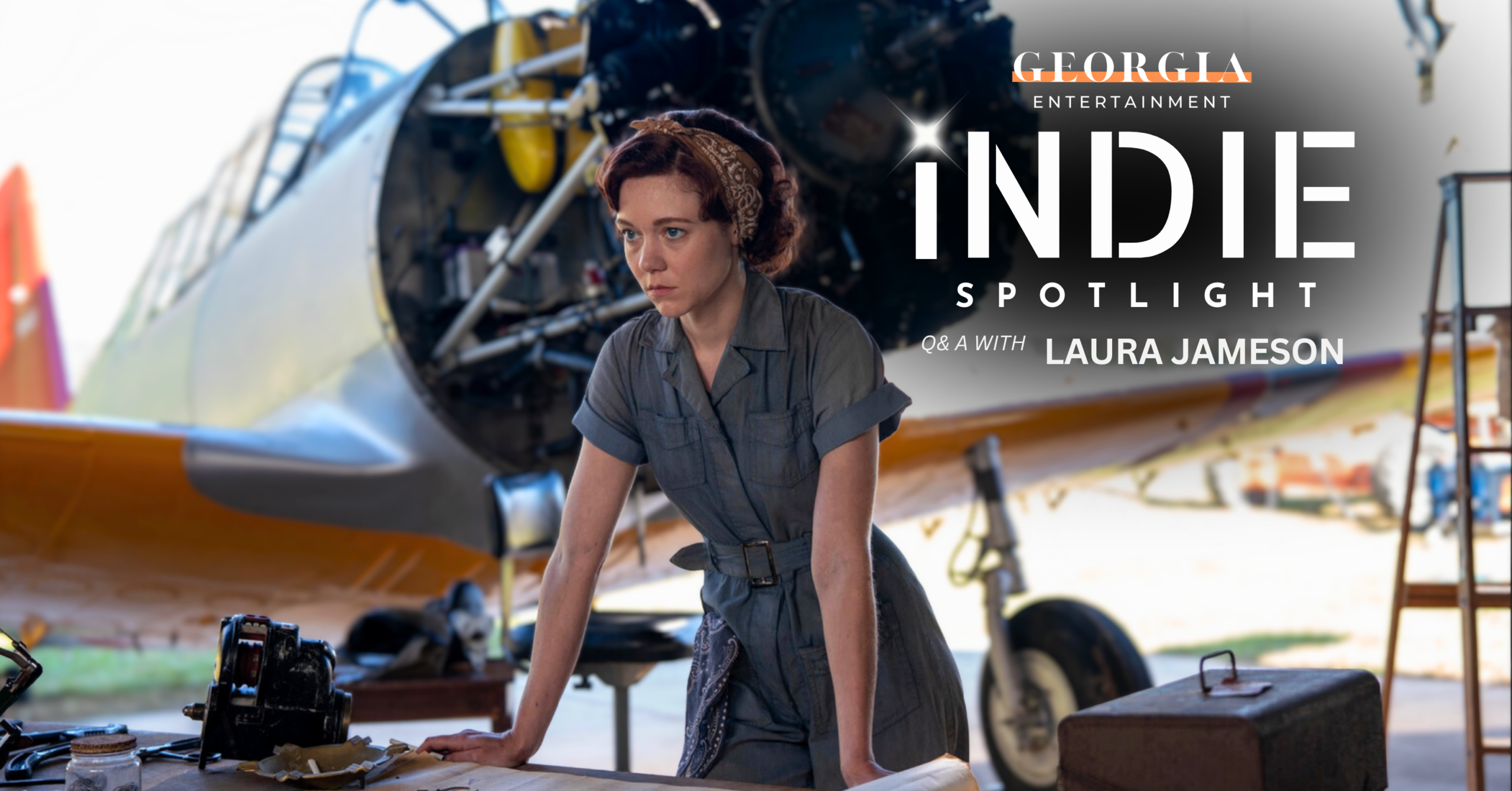
Director and producer Laura Jameson sat down with Georgia Entertainment to discuss “Into the Blue,” a short film that follows Hazel Raines, Georgia’s first licensed female pilot, as she chases a life in aviation and refuses to let anyone stand in her way. Developed as a thesis project through the SCAD MFA program in Savannah and made with a Georgia-based cast and crew that grew to 83 people, anchored by an almost entirely female senior producing team, the film recreates a chapter of World War II aviation history with vintage aircraft drawn from Kermit Weeks’ Fantasy of Flight collection.
Learn more about the Georgia Entertainment Indie Spotlight series:
Additional coverage | Newsletter | Event
Can you tell us about “Into the Blue” and what first drew you to the story of Hazel Raines?
JAMESON: Oh my goodness, there is so much to fall in love with in Hazel’s story. From the moment I found her, she consumed my world. Georgia’s first licensed female pilot, secret missions during World War II, the Air Transport Auxiliary, the WASP. She lived this extraordinary life, representing hundreds of extraordinary women at a time when the world needed them, and yet somehow very few people know her name. There was so much awe and excitement in discovering her, but also sadness that these women had been buried in history. Much like “Hidden Figures” or “A League of Their Own,” they defied expectations, chased their dreams, and stepped forward when history called. Hazel became our first glimpse into a history far bigger than we realized, and from the very beginning, I knew her story was somehow part of my own. “Into the Blue” follows her journey toward becoming a pilot, her love of aviation, her natural talent, her relentless pursuit of Captain Rockcliff, and her refusal to be stopped by the people standing in her way. This little short was never meant to tell every chapter of her life. It captures the moment that embodies who she was: courageous, relentless, kind, completely in love with flying, and unwilling to accept no as the final answer. Hazel became a defining pillar for this team, and just as she opened the door for us into the larger world of the WASP, we hope this film opens that door for audiences too.
You developed the film as part of the SCAD MFA program. How did SCAD’s creative community, resources, and talent help shape it from an idea into a finished film?
JAMESON: I always knew I was going to make something crazy ambitious in school. I just don’t think SCAD realized quite how ambitious I was going to get. Once I transferred to Savannah and saw the sheer volume of resources on campus, I started looking at SCAD almost like a creative incubator. Nearly every discipline you would find on a tentpole film was represented, alongside state-of-the-art facilities and this enormous pool of young talent desperate to create. Basically, I had the space to make it. Then I found my people. Sarah Wilhelm and Marija Krkovic went step for step with me through this entire journey, and together we started treating SCAD like our own little production studio. Sarah brought the writing world, Marija had this extraordinary student network, and we just started building. SCAD never made it easy, but they also did not tell us no. They made us prove ourselves at every stage, and we kept proving it. We also had professors and staff who really went there with us. Michael Chaney taught me how to strip a story down and understand why every choice on screen mattered. Renee Bishop became an extraordinary creative and professional mentor. Lubomir Kocka pushed me relentlessly to think 360 degrees and become a stronger director. Dr. Adrienne Boner and Morgan Harrigan helped us solve enormous production and safety challenges. But the greatest resource SCAD gave us was the people. The students on this film were some of the hardest-working, most talented creatives I have encountered anywhere in my career. What you see on screen is hundreds of hands and thousands of hours from students, professors, alumni, and professionals all pouring their best into the same project.
The film is deeply rooted in Georgia, from Hazel’s story to the team, development, and production. What did it mean to tell it in the place where it originated?
JAMESON: There is something incredibly special about bringing Hazel’s story back home to Georgia. Every part of this film ran through the Georgia pipeline, from Hazel’s beginnings in Macon to my own career, the team we assembled, the aviation community, and the people who came around the project in support. “Into the Blue” became a love letter not only to Hazel and the women whose contributions were never properly recognized, but to the state itself. Georgia also gave me the foundation to pull off something this ambitious. I learned the industry here, working on major productions for Disney, Sony, Netflix, and Amazon and on stages like Trilith, Pinewood, Blackhall, and Eagle Rock. I had seen firsthand what was possible in this state, and I was able to pour everything I had learned back into a story that began here. Hazel’s story started in Georgia. Ours did too. Getting to let the place that shaped both Hazel and this team become part of the storytelling itself felt incredibly fitting.
Your team brings significant studio experience to this independent project. How did that background influence the way you approached the scale, technical challenges, and visual ambition of the film?
JAMESON: Honestly, that experience was the driving force. I had spent years in the studio system around people operating at an incredibly high level, and it shaped how I think about scale, preparation, leadership, and what it actually takes to get a huge idea across the finish line. With this film, prep was everything. We lived by that old rule: good, fast, or cheap, pick two. We wanted good and we needed cheap, so it was not going to be fast. We built low and slow, starting almost a year before production, working the script months ahead of thesis prep, building detailed calendars, holding regular department meetings, and giving everyone as much visibility as possible. A lot of those blueprints came directly from people I had watched. Mo Marable taught me that a director has to think 360, Ruben Fleischer showed me what that looked like at scale, and I had a tiny glimpse of the earliest prep on “Wicked” with Jon Chu years ahead of photography. On the producing side, Beau Flynn, Matt Spiegel, and Marc Evans each taught me different versions of excellence in communication, logistics, adaptability, and leadership. Then we surrounded the project with people who could raise the ceiling. Annie Steinlage came aboard after years of working together in the studio system, along with mentoring producers Ken Goldwasser and Layne Brightwell, both highly accomplished professionals with extensive large-scale production experience. J.D. Schwalm and Innovation Workshop built our plane rig. Mike Baierski helped anchor aviation safety and logistics. Brenden Mascherino brought extraordinary visual instincts, Mason Weigen-Coburn shaped the film in the edit, and Wes Barker helped bring it home through VFX. Just as importantly, our students were working beside those professionals and rising to meet them. By the time we reached set, we had airplanes, special effects, virtual production, vehicles, period environments, and a lot of big machinery, but because we had spent so long building the foundation, it felt less frightening than exhilarating.
The film recreates a period of aviation history and Hazel’s experience as a pioneering female pilot. What were the biggest challenges in creating that authenticity, and how did you solve them as an independent production?
JAMESON: First and foremost, what an insane idea. Where in the heck did two girls from SCAD think they were going to get vintage airplanes? And because apparently that was not difficult enough, we made it a period piece too. The breakthrough came through Brittany, our lead actress, who had worked in vintage restoration and knew Kermit Weeks. A few weeks after she put us on the phone with him during an early shoot, Sarah, Brittany, Mike Baierski, and I were driving to Fantasy of Flight to meet him. Kermit is an absolute legend in aviation, and he was unbelievably generous with us. He taught us everything from broad flight principles down to details as tiny as the cotter pin on the front of the aircraft, opened his collection and team to us, and continued giving notes through production and into the final edit because he wanted the aviation to feel true to people who genuinely know that world. We immersed ourselves anywhere we could. We made repeated trips to Fantasy of Flight, visited the Mighty Eighth Museum, Hazel’s grave, and the airport where she learned to fly, and Kermit even took Eli and me into the air so we could understand what sitting in one of these aircraft actually felt like. Mike Baierski brought decades of Coast Guard search and rescue, aviation, stunt, marine, and safety experience, and my stepdad, a former naval pilot, was constantly sending me flight footage, angles, and technical details. I think being this strange hybrid of student film and professional production actually helped us, because we had no problem saying, “We don’t know. Teach us.” That willingness to invite experts into the work is what gave the film its authenticity.
The project brought together filmmakers, artists, craftspeople, and production talent connected to Georgia. What did the local creative ecosystem make possible that might have been difficult elsewhere?
JAMESON: Georgia is really the umbrella all of this falls under. We have talked about SCAD, the studio system, the aviation community, and the professionals who came aboard, but those worlds were able to collide because they exist here. I had spent nearly a decade working and building relationships in Georgia before making this film, so suddenly we had this extraordinary pool of filmmakers, artists, craftspeople, students, technicians, aviation experts, and industry professionals to pull from. What made it even more special was that the generosity extended far beyond the film industry itself. Our antique dealer, Dave Burchstold, is one of my favorite examples. I met him my first week living in Savannah, and years later he essentially donated the props and set dressing for both our early proof of concept and this film because he believed in what we were building. His son even came down and worked on set. That spirit happened over and over again. Students worked beside seasoned professionals. Local businesses contributed alongside major industry craftspeople. People like Dave, Kermit Weeks, Ken Goldwasser, Layne Brightwell, and so many others put their fingerprints on this film simply because they connected with the story and wanted to help. On paper, a production at our scale probably should not have been possible with the resources we had. But Georgia has this incredible depth chart of talent, knowledge, relationships, and people willing to roll up their sleeves and get in the trenches.
At its heart, this is a story about a woman who refused to accept the limitations placed on her. What do you hope audiences take away, and from seeing it told by the next generation of Georgia filmmakers?
JAMESON: Our hope is that people watch Hazel’s story and find a small piece of themselves in her journey. Her story is one of grit and determination, of refusing to take no for an answer, but all of it wrapped in kindness. She did not shy away when the world told her no, and she did not wait for anyone else to catch up. She moved forward anyway. Hazel did something extraordinary at a moment when history depended on women like her, and in doing so helped break down barriers for the generations that followed. In a way, her legacy became part of our own. Years ago, I sat in a major studio production meeting with 74 department heads. There were four women in the room, and three of us were assistants. I remember thinking, I never want the numbers to look like this again. On this film, our crew grew to 83 people, with an almost entirely female senior producing team and women working and leading across nearly every department. There are young filmmakers coming up behind us who will enter this industry having already seen women leading the room, not as the exception, but simply as part of what a film set looks like. Hazel proceeded anyway in aviation. We get to do it in filmmaking. My hope is that the next generation gets to start even further down the runway because of it.
You’ve described the film as both a preservation of Georgia history and a showcase of what the state’s creative community can accomplish. Where do you think Georgia’s independent filmmaking community is headed next?
JAMESON: This question excites me most of all, because I love this state, and I would love to stay here and keep building here. I truly believe “Into the Blue” is only a drop in the bucket of what Georgia is capable of. For years, we built an extraordinary production engine here. Thousands of people learned how to make enormous films at the highest level, and now there is this incredible generation of experienced writers, directors, producers, artists, and craftspeople ready to build work of their own. The talent is here. The crews are here. The infrastructure is here. The stories are absolutely here. The piece so many of us are still trying to solve is financing.
 The Georgia Entertainment Indie Spotlight, sponsored by Universal Production Services at Assembly Studios, is a recurring feature dedicated to showcasing independent filmmakers with strong ties to Georgia. Through written Q&As, profiles, and other coverage, we aim to celebrate the creativity, resourcefulness, and impact of local filmmakers who are contributing to the state’s growing film ecosystem.