Free Atlanta Premiere at Rialto Center for the Arts on Sept. 7. Documentary Also Premieres Nationally on PBS Award-Winning Series “American Experience” on Sept. 12
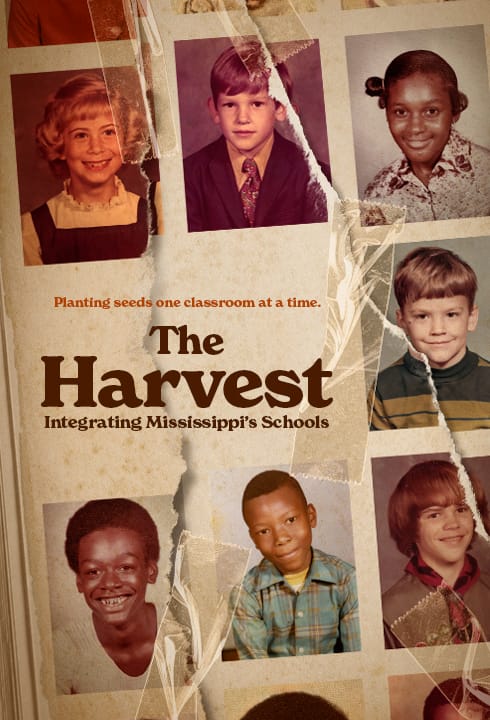
Pulitzer Prize-winning Atlanta-based author Douglas A. Blackmon looks back on his experience as a member of the first class of Black and white children to attend all 12 grades together in Leland, Miss., in his new documentary, “The Harvest.” The film has already been named a finalist for the Library of Congress Lavine / Ken Burns Prize for Film.
The Atlanta premiere of the documentary will take place at the Rialto Center for the Arts on Thur., Sept. 7 at 6:30 p.m. The ticketed event is free and open to the public. Tickets are available now through Georgia Public Broadcasting HERE. The evening will include a post-film panel moderated by Dr. Clarissa Myrick-Harris, professor of Africana Studies at Morehouse College, and with “The Harvest” producers, Blackmon and Academy Award-nominated documentary filmmaker and producer Sam Pollard.
Additional screenings of “The Harvest” are taking place in Leland and Jackson, Miss., Little Rock, Ark. and Washington, D.C., with more to be announced.
Executive produced by Cameo George, “The Harvest” is a deeply personal depiction of one Southern town’s painful struggle to integrate its public schools and the continuing repercussions still felt more than 50 years later. The film was produced in cooperation with Georgia Humanities, and the Atlanta premiere event is supported by The Wilbur and Hilda Glenn Family Foundation and The Rich Foundation.
The film will also premiere on the PBS award-winning series “American Experience” Sept. 12 at 9 p.m. ET (check local listings),including locally on GPB. The broadcast is part of a special two-night event exploring the mixed legacy of school integration on PBS, PBS.org and the PBS App. “The Harvest” will be preceded on PBS by the premiere of “The Busing Battleground” on Sept. 11.
After the 1954 Supreme Court’s landmark Brown v. Board of Education decision ruled that racial segregation in public schools was unconstitutional, little more than token efforts were made to desegregate southern schools. That changed dramatically on Oct. 29, 1969, when the high court ordered Mississippi schools to fully — and immediately — desegregate. As a result, a group of children, including six-year-old Blackmon, entered school in the fall of 1970 as part of the first class of Black and white students who would attend all 12 grades integrated together in Leland, Miss.
“It’s taken 10 years to finally finish this very personal film. It’s about my Mississippi hometown, the children I grew up with, pathways they followed to become heroic men and women today, our parents and teachers facing a challenge they could never have fully imagined, remarkable acts of principle and bravery, villainy, inevitable human mistakes, a loss of innocence personal and writ large, all in the face of what remains the greatest paradox of American life,” said Blackmon. “We have made so much progress over the past 50 years toward genuine human equity, yet still our society is tortured by racial injustice and the danger it poses to us all.”
“Georgia Humanities is proud to support ‘The Harvest.’ The film not only shines a light on a significant chapter here in the South, but also challenges us to learn from our shared history to build a brighter and more inclusive future,” said Georgia Humanities Vice President Kelly Caudle. “This screening is only the beginning, as we, over the next year, will be uncovering more of Georgia’s desegregation stories.”
Set against vast historic and demographic changes unfolding across America, “The Harvest” steps back in time to explore Mississippi’s brutal history of racial intolerance and segregation — a world in which schools for Black children were not only separate but deeply underfunded, often inaccessible, and sometimes nonexistent.
“The Harvest” follows the brave coalition of Black and white citizens who worked to create racially integrated public schools in the most unlikely place: a 1960s cotton town in the middle of the Mississippi Delta, the most rigidly segregated area in America. It tells the extraordinary story of how that first class became possible, then traces the lives of Blackmon and his classmates, teachers and parents through high school graduation in 1982. It is a riveting portrait of how those children’s lives were transformed and how the town — and America — were changed. But as the film follows the lives of those children into the present, it is also a portrait of what our society has lost in its failure to finish the work begun a generation ago.
Narrated by Blackmon and featuring candid interviews with his fellow pupils and others, the film follows the experiences of his class through school integration, deep friendships and awkward separations, in classrooms and on playgrounds, in plays and athletics, at homecoming and graduation. The film reveals that while many interracial friendships were formed in school, racial divisions often still existed outside the classroom.
Moving into the present, “The Harvest” discovers that the success of those first years of integration has gradually fallen apart. In the 50 years since Blackmon and his classmates began first grade, the local economy faltered and white families almost entirely abandoned public schools. And, as the schools once more became racially divided, the town’s racial divisions have deepened. But even amid those disappointments, many members of that first class have returned to Leland, committed to giving back to their community. Blackmon finds hope in the lives of his classmates, who have gone on to become the town’s police chief, a federal judge, an Army colonel, a high school deputy principal, and a school superintendent. Through the story of Leland, “The Harvest” paints a fascinating portrait of one town and one extraordinary class of students, and offers a timely look at the continuing challenges of racial division and education equity still facing America today.
American Experience “The Harvest” will stream simultaneously with broadcast on all station-branded PBS platforms, including PBS.org and the PBS App, available on iOS, Android, Roku, Apple TV, Amazon Fire TV, Android TV, Samsung Smart TV, Chromecast and VIZIO. The film will also be available for streaming with closed captioning in English and Spanish.
FREE PREMIERE SCREENING* | “THE HARVEST”
Rialto Center for the Arts, Georgia State University
Thur, Sept. 7 | Doors: 6 p.m. | Screening: 6:30 p.m.
* Reserve free tickets at Georgia Public Broadcasting