
In Georgia, secondary education is transporting students into a whole new realm, answering the demand for a skilled, creative workforce in the process
By Carol Badaracco Padgett
Inhale slowly for a count of five. Hold your breath at the top. Then exhale slowly for another five beats. Inhale slowly again for five beats, holding your breath at the top … and exhale for a count of five.
Relax the muscles in your face, the space between your brows, your jaw, and your shoulders. Let go of all the tension in your body.
Now, allow your imagination to transport you back in time.
You’re 16. And you’re moving lightly and electrically through the halls of your high school. It’s the one you remember, but different somehow … flowing with its own creative current.
Now just imagine, this school and its classes are your chance to set the stage for the rest of your life.
For secondary students in Georgia today, this educational experience is a reality and not a reverie.
Central Film Academy – Forsyth Central High School | Cumming, Georgia
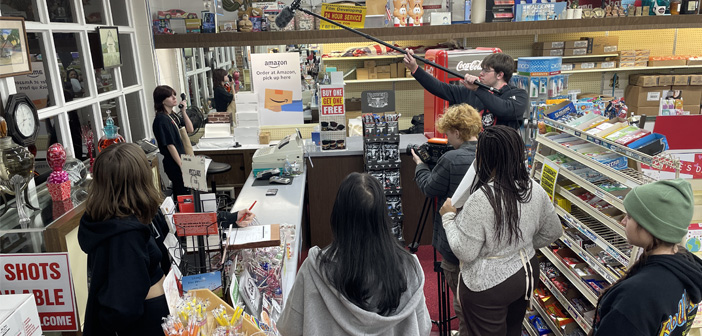
Jason Hanline has created a high school program for students that’s designed to answer the creative industries’ demands for a skilled, imaginative workforce. As the lead teacher of Central Film Academy in Forsyth Central High School’s AV Film and Tech department in Cumming, Georgia, he is on a journey since the program began five years ago.
“I wanted to be in filmmaking when I was young,” Hanline says. “But I would’ve had to leave Georgia and I didn’t want to do that. Plus, I love teaching.”
With the film industry alone contributing billions annually to the Peach State’s economy, the timing is right for budding creatives to board Hanline’s train of thought. The industry is resilient, too, weathering storms such as strikes and sidestepping threats to limit tax incentives.
When the economic growth of the industry is paired with students’ drive toward a creative career, the promise of Hanline’s program becomes palpable. And attainable. At Central Film Academy, Hanline’s students have all the tools they need to learn, practice, and produce films in a studio-like environment.
“It’s very gratifying to help point my students in the direction of such a viable opportunity,” Hanline notes. “I can help get others [pointed]in the right direction so they can do it, even if I couldn’t.”
Hanline’s sentiment doesn’t signal the deflation of his own dreams, though. It actually means that doors opened in his film career journey in ways he couldn’t have imagined. In essence, teaching his students in Georgia has become his personal stepping stone into the film industry.
“My class and I had the opportunity recently to work on a film set,” Hanline gives as an example. The film, “The Fabulous Flocks,” was about a Georgia family prominent in the inception of NASCAR.
“I took current students and made them PAs, and we had kids in front of and behind the camera. I was also able to help the professional filmmakers gather up extra footage for a scene shot in the 1950s. And our theatre teacher helped come up with wardrobe from the ‘50s,” he says.
Hanline served as the key PA that day on set, as well, for the filming of a dirt track racing scene he describes as long and hot. “It was dusty and we were all sunburned, but we had a great time,” he says.
“I’d love for more people in the industry to see and realize the opportunity at hand and give us one day of work on set, like we just did with these kids,” he says.
Many of Hanline’s Central Film Academy students seek certification that lets them step straight from high school graduation into a career in the film industry, through the Georgia Department of Education’s Career Technical & Agricultural Education (CTAE) program, of which the academy is a part. Others use their CTAE certification to help enter post-secondary education programs.
Athens Community Career Academy (ACCA), Athens High School | Athens, Georgia
Less than an hour and a half northeast of Forsyth County High School and Central Film Academy, high school teacher Michael Bosby is on Hanline’s wavelength.
Bosby teaches film and video at ACCA for grades 10-12, and he also teaches at two additional secondary schools in Athens — Clarke Central High School and Cedar Shoals High School.
At all three he teaches the same subject: all aspects of film production.
Bosby started his career working for community cable stations in Chicago before he and his family moved to Georgia 24 years ago. He and his wife are also producers and directors at a television network they founded in Athens, The JPN Network.
Today, Bosby is teaching and giving kids the chance to love a lifelong TV and film career as much as he has. “If students take my Film I class at high school and pass, they get to do Film 2 and Film 3 at ACCA. Then, in Film 3, they take a test for state certification that says they’re ready to work in the industry,” he notes.
“It’s giving them an option,” Bosby continues. “When we grew up you had to go to college, but now you can go straight into pathways education and walk right into the studio.”
For some of Bosby’s students, that studio is 84,000-square-foot Athena Studios and its state-of-the-art, professional, purpose-built sound stages. Incidentally, in November of 2022 a sound stage at the studio was dedicated as a learning center for students at the University of Georgia and the Georgia Film Academy (GFA), a not-for-profit Atlanta-based entertainment arts program that works in collaboration with the Technical College System of Georgia and the University System of Georgia. So for students who want to take training beyond high school before stepping into the industry to begin their careers, that option exists.
And that’s Bosby’s mission: giving Georgia students options for building creative careers in the sizable local film and entertainment industry. It’s a vision he has keenly focused on from the time he started teaching, with only one camera — before scores of donors stepped up and helped provide multiple 6k cameras and the top-of-the-line gear his students use today.
“Georgia is now the hub of the film industry, and there’s so much film work here,” he notes. “After you get your program certification and build your network, you can start your own film production company, for example, or hire yourself out to do weddings and events.”
Bosby, an independent producer when he’s not teaching, has experienced and profited from all the options himself. Just last year he introduced a film onto the festival circuit, where it has captured 10 awards so far. In tandem, he’s working toward becoming a drone pilot for film.
Circling back to his students and their aspirations, he knows from firsthand experience that the sky is not even the limit in the Peach State. “There are films and TV shows shot here – and people know about Georgia. Next year Athena Studios [has a project]on the table that’s filming in Georgia. The industry is booming and now is the perfect opportunity to get into it.”
Bosby adds, “I’m grooming my students to be homegrown and stay here in the film industry if they wish.”
Utopian Academy for the Arts, Charter School Network | Ellenwood, Georgia
About 25 minutes southeast of downtown Atlanta, a charter school network called Utopian Academy for the Arts is devoted to training students for an entertainment arts education and ensuing careers in the creative industries.
The academy’s founder and CEO, Dr. Artesius Miller, is committed to a vision similar to Hanline’s and Bosby’s.
With the goal of funneling Georgia secondary students straight into entertainment industry careers — or post-secondary education programs, if they choose — Utopian Academy offers coursework in fashion, animation, gaming design and development, and filmmaking through a curriculum taught by industry professionals. The school’s course catalog also includes broadcast and video production, chorus, dance, digital art and design, journalism, music appreciation, music production, theatre, piano, and visual arts.
“When we were coming up with our [educational approach and curriculum]design at Utopian, the arts had been taken out of schools,” Miller states. “We chose our arts-based model because research shows the importance and value of an arts-based education and how it benefits students.”
Miller says it wasn’t long after that Utopian Academy for the Arts moved from being a vision in his mind to a brick-and-mortar reality in 2014.
“We wanted a school that would serve the student,” he notes — for careers as writers, actors, directors, producers, and many other roles. Individual talent and organizations come to Utopian to serve students, as well, with several examples being Alvin Ailey and the Atlanta Ballet.
“I’m always going to push for us to extend partnerships,” Miller states. “We want to be a touchpoint for any entity in this space to know that we exist and that we have a pipeline of young men and women in all lines of the industry — from film, television, and animation to roles above-the-line and below with the goal of storytelling.” In essence, Utopian wants its students to be able to fill every role listed in the credits at the end of a film.
“Now that Georgia has become the entertainment capital of the world, we are organically creating the workforce our state really wants,” Miller says.
As with Hanline and Bosby, Miller’s goal is to allow Utopian students a pathway they can start post-secondary, if they wish — or to enter the university system as the next step on their creative arts career journey.
Miller stresses that diversity, too, is an intentional part of Utopian Academy’s ultimate mission.
“We are clear about making sure we work as a representative of the underserved in Clayton County, serving predominantly students of color.
We want the same level of access to the industry for them, and we are intentional about that,” he said.
This article appeared in the 2025 edition of the Creative Economy Journal. See more from the Journal here.