
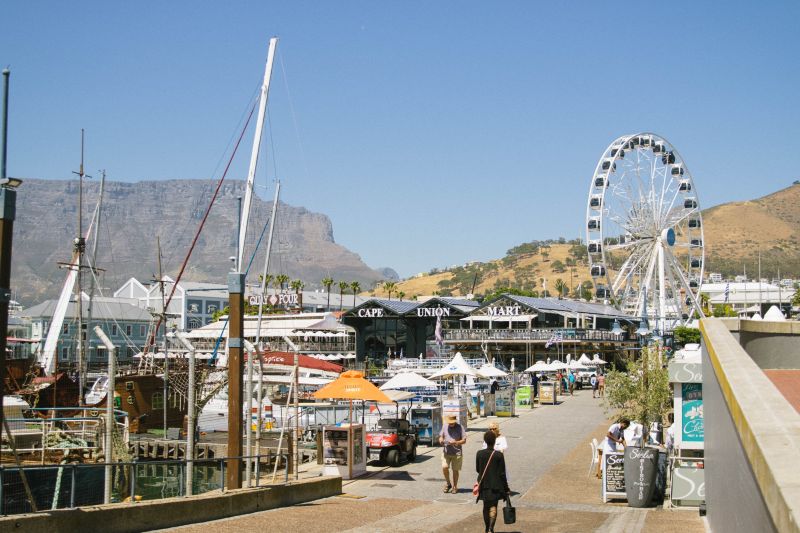
Last fall, I had the opportunity to spend nearly a week in South Africa, and I returned with a profound sense of the vast opportunity that lies within this country. South Africa is often celebrated for its breathtaking beauty—its mountains, wildlife, and world-class wine regions. Beyond its natural wonder, however, it is a country brimming with business potential. From fintech to film and food to fashion, it offers an expansive landscape of opportunity.
My trip was part of a broader Africa mission that included traveling with Atlanta Mayor Andre Dickens and a group of dynamic creative leaders to Cape Town for FAME Week Africa, the continent’s premier creative industries festival. The 2025 Atlanta delegation was organized and led by MASSIVE: ATL/GA, a coalition of influential creative leaders committed to expanding Georgia’s global footprint and building meaningful bridges to Africa’s creative economy.
FAME Week Africa draws innovators in music, film, fashion, and business from across the continent and beyond, creating a hub for collaboration and trade. That experience gave me a new lens on what is possible: co-productions, partnerships, and ventures that connect Atlanta’s creative energy with South Africa’s innovation.
I also traveled to South Africa in part to visit the Cape Town office of my London-based fintech client, ekko.earth. Just weeks earlier, Mayor Dickens and Senior Tech Advisor Donnie Beamer had welcomed ekko’s founders to Atlanta during Venture Atlanta, where we helped make the case for launching their North American headquarters here. Soon after, I was in Cape Town meeting their software development team and seeing how the city’s deep tech talent is building a global fintech-meets-sustainability platform.
In January, that work paid off: ekko announced it would open its North American headquarters in South Downtown, choosing Atlanta over traditional markets like New York and Silicon Valley.
Key to the expansion of trade between Georgia and South Africa is the infrastructure that connects us. The Georgia Ports Authority based in Brunswick facilitates container services to South African ports, including Durban and East London. Meanwhile, Delta Air Lines provides direct air cargo links from Hartsfield-Jackson Atlanta International Airport to Cape Town, ensuring goods and business leaders can move efficiently between our markets.
Direct passenger flights make an equally significant impact. In 2024, Hartsfield-Jackson saw more than 500 flights carrying over 120,000 passengers between Georgia and South Africa, with traffic expected to grow in 2025. Nonstop routes to Johannesburg and Cape Town reduce both physical and logistical barriers, making trade, talent exchange, and tourism far more seamless.
These logistics are more than conveniences. They are engines of economic growth. In 2023, Georgia exports to South Africa totaled $136 million, making it the state’s 49th largest export market.
On paper, that may not sound significant. In reality it signals untapped potential. South Africa is the most industrialized economy on the continent and a gateway to broader African markets. Georgia’s top exports: poultry, chemical wood pulp and aircraft parts, reflect sectors where our state leads nationally and globally.
That same year, Georgia imports from South Africa totaled $540.4 million, ranking it 31st among Georgia’s importer nations. This imbalance underscores opportunity: there is substantial room to deepen outbound trade and position Georgia companies more aggressively in a market that is already commercially connected to us.
Atlanta is also home to a significant African diaspora, including a vibrant South African community that contributes to the cultural and economic fabric of our state.
Organizations such as the South African Chamber of Commerce USA, established in 2009, actively promote business, trade, investment, and cultural exchange between South Africa and the United States. These networks provide continuity beyond official delegations and trade statistics, ensuring that relationships endure at the community and entrepreneurial level.
As Atlanta prepares to welcome the world for eight matches during the FIFA World Cup 2026, one group match stands out as another powerful link between our regions. South Africa will play a to-be-determined opponent at Mercedes-Benz Stadium on June 18.
South Africa’s legacy as the first African nation to host the FIFA World Cup in 2010, combined with this upcoming match in Atlanta, underscores the connective power of sport. Events like these energize diaspora communities and demonstrate how global platforms can deepen cultural and economic ties.
History deepens that connection. Atlanta was the cradle and a center of the American Civil Rights Movement; South Africa endured and ultimately dismantled apartheid. In both places, progress required more than rhetoric—it demanded structural change, courageous leadership, and policy decisions that expanded access to opportunity. These histories remind us that systems do not evolve on their own. They are shaped by deliberate choices. Those lessons remain relevant as we work to build growth that is inclusive, competitive, and globally engaged.
Public investment in global education is another way Georgia spans oceans. The HOPE Scholarship—a merit-based program funded primarily through state lottery proceeds—is a direct investment in our next generation, covering a significant portion of tuition for students who meet academic standards.
Importantly, that support extends to study abroad programs. It enabled my daughter to participate in a University of Georgia Maymester in Stellenbosch, where she studied the economic, social and political ties between our two regions. Policies like this do more than fund degrees. They expand horizons, cultivate global competence, and prepare generations to operate beyond state and national borders.
The University System of Georgia offers more than 20 study abroad programs in South Africa across disciplines including business, public health, animal science and international affairs. In fall 2024, 142 South African students were enrolled in USG institutions. These exchanges build relationships that endure long after graduation.
South Africa, with its dynamic markets and innovative spirit, is a natural partner in Georgia’s unfolding future. From the ports in Brunswick to the classrooms in Athens, these ties continue to deepen. They remind us that the economic and policy choices we make in Georgia carry global consequences.
By strengthening these connections, we are not simply expanding markets—we are building durable bridges of shared growth.