By Jordan A. Rothacker
SNAP has always been a hot topic in our political climate. Now the issue is nearing a boiling point. Once called “food stamps,” the Supplemental Nutrition Assistance Program has been a key target in the government as of late. The most recent Georgia legislation, HB 947 (the SNAP Integrity Act) was adjudicated so ardently the bill was not passed until the late hours of March 7, the day after Crossover Day.
For around 60 years the Department of Agriculture has administered SNAP benefits. According to the USDA website, “SNAP provides food benefits to low-income families to supplement their grocery budget so they can afford the nutritious food essential to health and well-being.”
Recipients are able to use these benefits – alloted funds – through a digital system called Electronic Benefits Transfer, or EBT.
SNAP is paid for by the federal government, but each state splits evenly the administrative costs of the program. But not for long. In October as part of the “One Big Beautiful Bill Act” or H.R. 1, cost splitting will change – the state will have to pay 75% of the overall administrative costs.
There’s another concerning piece in H.R. 1. Soon, a state could incur penalties for a SNAP error rate over five percent. In 2024, the USDA estimated Georgia’s SNAP payment error rate to be over 15%.
Georgia’s SNAP Integrity Act is clearly motivated by the new regulations from H.R. 1. The bill brings greater scrutiny to recipients, and its abstract describes “restrictions on broad based categorical eligibility, gross income standards and allowable financial resource standards.”
A later section said “No individual or family may receive SNAP benefits in this state unless such individual or family: Verifies United States citizenship at application and recertification, consistent with federal law.”
As SNAP benefits come from the federal government, these stipulations about access to the benefits within the state could be seen as extra and even redundant procedural hurdles.
Section H addresses where the benefits can be used. It says “SNAP benefits shall not be used to purchase: (1) Foods or beverages in a food service establishment.” This is part of the national debate that has always been had around the formerly named “food stamps.” How are recipients using these benefits? What products are allowed and what products aren’t, and where?
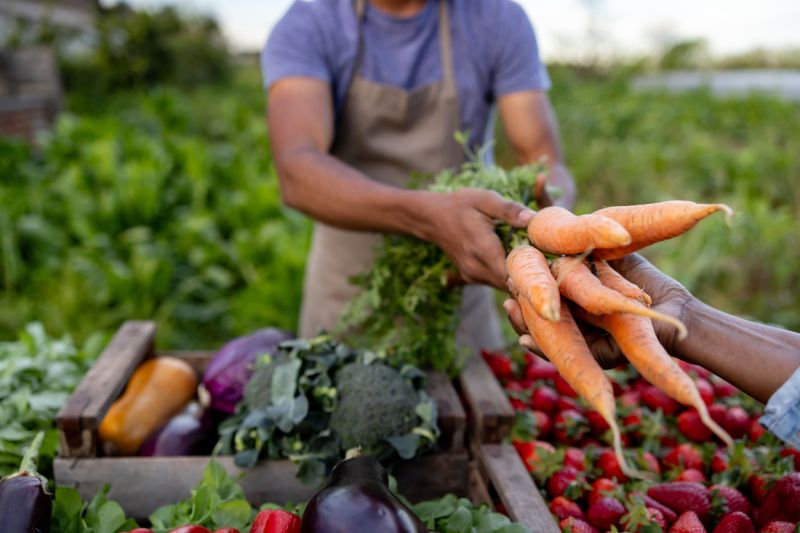
Section F of the bill laid out a contrast to the limitation. It states the Georgia Department of Agriculture may identify and pursue grants, pilot programs and technical assistance to “support and expand the use of SNAP at local farmers markets, provide training and assistance for farmers markets and agricultural vendors seeking SNAP authorization and promote participation by vendors offering fruits, vegetable and meats that comply with this Code section.”
The bill would help expand state-wide access to SNAP eligible agricultural vendors.
Armchair ethicists may want to weigh in on how SNAP recipients spend their so-called “stamps” and other money, but there are organizations in Georgia working to make the program a greater benefit to everyone involved – the recipients, the Georgia-based industry vendors and the government.
Wholesome Wave Georgia (WWG) is one such organization. It has been active in the state since 2009 as a state-specific spinoff of the national Wholesome Wave nonprofit. WWG’s mission is to make “fresh, healthy, locally-grown produce affordable and available to all Georgians.”
The organization has three core programs, two of which involve SNAP benefits. “Fresh for Less,” WWG’s cornerstone, is a program that matches SNAP and EBT funds dollar for dollar at participating markets and retailers for locally grown produce.
WWG also offers “SNAP Connection,” a program for free screenings, applications and renewal assistance for SNAP and EBT.
Wholesome Wave Georgia’s Director of Programs Abigail Darwin spoke to Georgia Insider about the recent legislation moving through the State House of Representatives, and how it could impact not only Georgia recipients but also the industries connected to fresh food ecosystems across the state.
“First, I’m not an economist, I can only comment on what I’m seeing on the ground at farmer’s markets, and discussions that I’m having with farmer’s market managers, farmers and grocery store owners. But SNAP is a huge industry,” Darwin said.
She took the call as she walked out of the opening day of the Athens Farmer’s Market, which works with WWG to double SNAP dollars for market shoppers.
“It’s a $9 billion a month industry across our entire country. It’s really keeping a lot of the organizations that we know and love afloat. It’s keeping our Targets afloat, it’s keeping our Walmart markets afloat,” Darwin said. “That’s a huge percentage of their shopper demographic. But what people don’t know and understand is that it’s also keeping, in addition to those box stores like Target and Walmart, it’s also keeping our farmers markets afloat.”
Darwin said she understood the “intentionality” behind the bill, and its goal to save taxpayer dollars. But she worried adding formalities to SNAP applications will decrease the number of Georgia residents receiving benefits.
“One of my concerns with this new bill is that if we’re adding more paperwork, if we’re adding more formalities to the SNAP application process, then what we’re ultimately doing is keeping Georgia families, working Georgia families, from accessing the food that they need to make it through day-to-day,” Darwin said.
She worries many Georgians don’t understand that SNAP is a “safety net.” Most people use the program for six months or less, when they’re between jobs or caretaking – times when financial assistance is essential.
“It’s really an assistance program that helps people bridge the gap so that they can afford to eat the food they need on a day-to-day (basis,) so that they’re ready to reenter the workplace,” Darwin said. “Because if you’re not accessing healthy, nutritious foods, you are not going to be a productive member of our economy and our society.”
She also answered a frequent claim that undocumented immigrants are able to access SNAP benefits. “They are not,” Darwin said. “That is a common misconception that undocumented folks in our community are able to access and benefit from SNAP.”
The bill isn’t all concerning to folks like Darwin. Some language like added formalities may be an issue, but the section designed to promote SNAP sales at farmers markets aligns with the nonprofit mission of access to Georgia grown food.
“There’s a lot of positives in this bill. I appreciate and I’m excited for the focus and intentionality behind including farmers markets in this bill,” Darwin said. “Because it’s been something that’s been historically overlooked. However, if we see a decrease in SNAP enrollment because of this bill that would impact our farmers’ take home at the end of the day.”