

by Michael Lewis
Last month Emory University announced a search for its next president. But it’s not just any search. It’s an explicit “national search.”
The phrase “national search” is routine across universities and other cultural institutions. There is a clear logic. The goal is to find the best talent, so the search is unconstrained. One wonders why they don’t call them “global searches.”
Who could argue with using unconstrained searches? Not me.
At least not conceptually, but as usual, the devil is in the details. There is an issue that doesn’t receive sufficient attention: Universities are not just any business, these are enduring cultural institutions embedded in specific communities.
The problem isn’t whether a search is national. The problem is whether a century-scale institution should be governed by a labor market built for six-year careers.
But this isn’t a thought piece about Emory’s presidential search. This is about the complexities of building cultural brands that operate over centuries – universities, sports franchises, ballets, museums – and the related issue of selecting and incentivizing leadership at organizations that outlive their managers by centuries.
Generational Brands
This is about a specific type of cultural brand – generational brands, cultural brands built to transcend time.
Now, we aren’t talking about Taylor Swift. She might be the most powerful cultural brand in modern America, but she will operate on a human life cycle.
We see generational brands in different categories and when you start listing them you realize we are talking about brands that define our culture: Universities. Harvard was founded in 1636, Yale in 1701 and Emory in 1836. High culture: The Bolshoi Ballet began in 1776, Teatro alla Scala in 1778 and the New York Philharmonic in 1842. Sports: The forerunners of the Chicago Cubs were formed in 1876, Manchester United dates to 1878 and the Green Bay Packers in 1919.
In addition to long histories, these organizations also all share something. They are all connected to specific places. Harvard isn’t just a university – it’s Cambridge and Boston. The Bolshoi is Moscow’s Ballet. The Cubs aren’t just a team – they’re Chicago’s North Side. These brands belong both to the world and to specific communities.
They aren’t quarterly earnings businesses, they’re permanent institutions with temporary employees, and institutions whose fans and patrons operate over decade-long cycles – the 10-year-old fan becomes a 50-year-old season ticket holder and the 17-year-old applying to her dream school becomes a 70-year-old donor.
Generational Brands versus Short Term Targets
Sports provide a more familiar and transparent lens to illuminate how generational brands work, and how they can be vulnerable.
The NFL’s top brands – the Cowboys, Packers, and Steelers – were built in the 1960s and 1970s. The 10-year-old watching Roger Staubach or Terry Bradshaw win Super Bowls in the late 1970s is likely still rooting for those teams as they approach 60. Generational sports brands are built by focusing on the 10-year-olds – the sweet spot varies by cultural category, but fandom (aka cultural passion) is overwhelmingly created with younger people.
But what happens when transactional leadership takes over? A leader focused on quarterly results looks at the current 60-year-old fan base and sees revenue opportunity, passionate fans with disposable income. They raise prices accordingly. The results look great: The NFL sets new revenue records each year, and ticket places have outpaced inflation by about 45% over the last 25 years.
The consequence shows up in the fandom data.
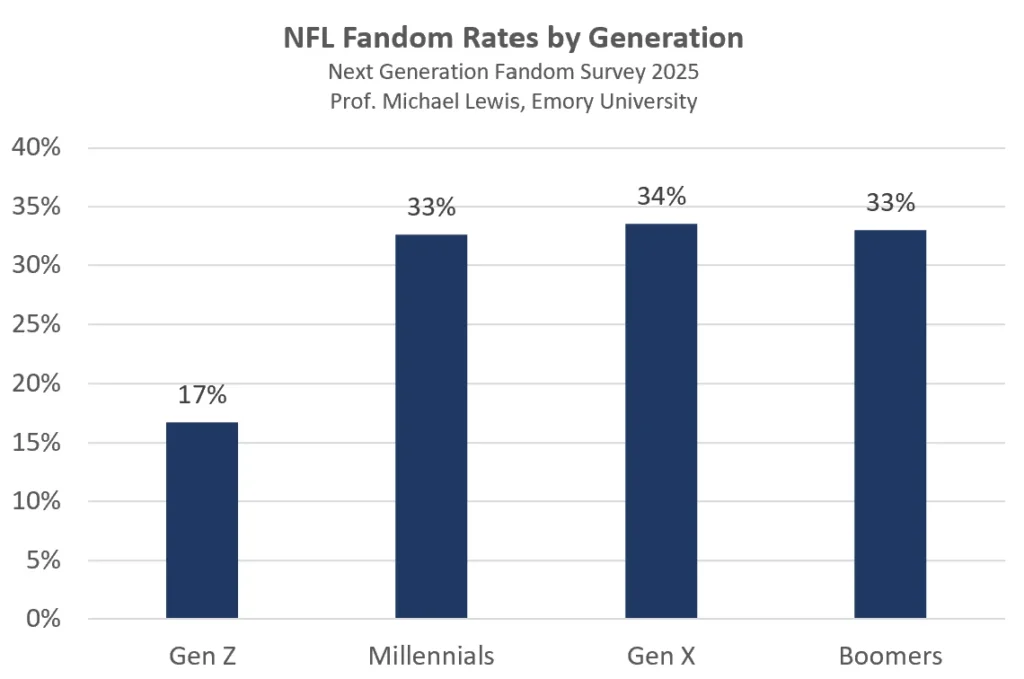
Baby Boomers, Gen X and Millennials all have NFL fandom rates around 33%. Gen Z? Just 17%, half the rate of older generations. There are multiple reasons for this, but pricing kids out of stadiums shouldn’t be discounted as a cause.
Fandom and passion were built over half a century, but when you aggressively monetize this fandom to optimize next season’s revenues you can lose an entire generation.
Universities as Generational Brands
The comparison of universities to sports franchises may seem off – it’s intellectual high culture versus face painting sports culture. But university applicants, students, and alumni frequently operate with the same passion and emotion as sports fans. The response to critiquing the academic reputation of an alumnus’ school can generate the same fury as bashing his school’s football team.
Higher education operates with an even more severe generational branding logic. Like sports, the top tier barely changes. The schools dominating college rankings in 2026 are essentially identical to those in 1976. A survey asking high school seniors (or their parents) about the “best” universities would probably yield the same names of Harvard, Yale, Princeton, MIT, and Stanford every year for the last fifty years. Reputation has been locked in for a long time.
In sports, the recipe for moving up the ladder is repeated visible excellence. I mentioned the Packers, Steelers, and Cowboys in the previous section – brands built in the 1970s. The Patriots have recently joined that top tier of brands by winning six championships in the last 25 years. The Patriots’ ascendance included stability at the ownership, head coach, and even quarterback roles.
Growing a university’s prestige or brand is even more daunting. There is no championship game watched by 125 million people.
But here’s the problem: Building or damaging a university’s reputation takes decades, while presidential tenures are collapsing. In 2006, the average tenure was 8.5 years. By 2016 it dropped to 6.5 years. In 2023 it was less than six years. Six years is not enough time to see the consequences of most strategic decisions on institutional reputation. Alumni loyalty, academic prestige and donor trust operate over decades, not budget cycles.
The National Search Problem
In principle, the National Search is the benchmark for talent acquisition – the unrestricted pursuit of excellence, whether it’s for a university president or a new head football coach. But there are four potential problems with national search culture.
- Misaligned incentives – National search culture exacerbates the mismatch between organizational and individual incentives. It creates a marketplace for leadership where institutions signal prestige by hiring from aspirational schools, and individuals signal elite status by moving between institutions. The result is a short-term oriented mobile managerial class leading century-scale institutions.
- The loss of local network capital – This might be best illustrated by thinking about college sports. A UGA coach who also played at Georgia is fully embedded in the local ecosystem. He knows Georgia high school recruiting networks, alumni culture and donor relationships. An external hire brings portable skills but not network capital.
- The stepping stone problem – The hierarchy in cultural brands means that the participants in the national market are often chasing ever more prestigious opportunities. I’ve seen multiple coaches leave my alma mater, Illinois, for blue blood programs – notably Bill Self to Kansas and Bill Mackovic to Texas. In football and academia the institution invests in an individual’s reputation, only to have the person leave for the next rung on the prestige ladder.
- A weakened internal talent development process – If leadership is always imported, institutional loyalty becomes irrational. Internal talent has little incentive to invest deeply in the local community if career advancement requires joining the national circuit, which doesn’t prioritize local relationships. The embedded cultural knowledge that makes institutions durable never accumulates.
Fool’s Gold?
National searches optimize for what is measurable in elite labor markets – prestige signals, mobility, visible projects – not what sustains generational institutions: century level reputation and brand building. For deeply rooted cultural institutions, the gold standard of searches may be fool’s gold.