
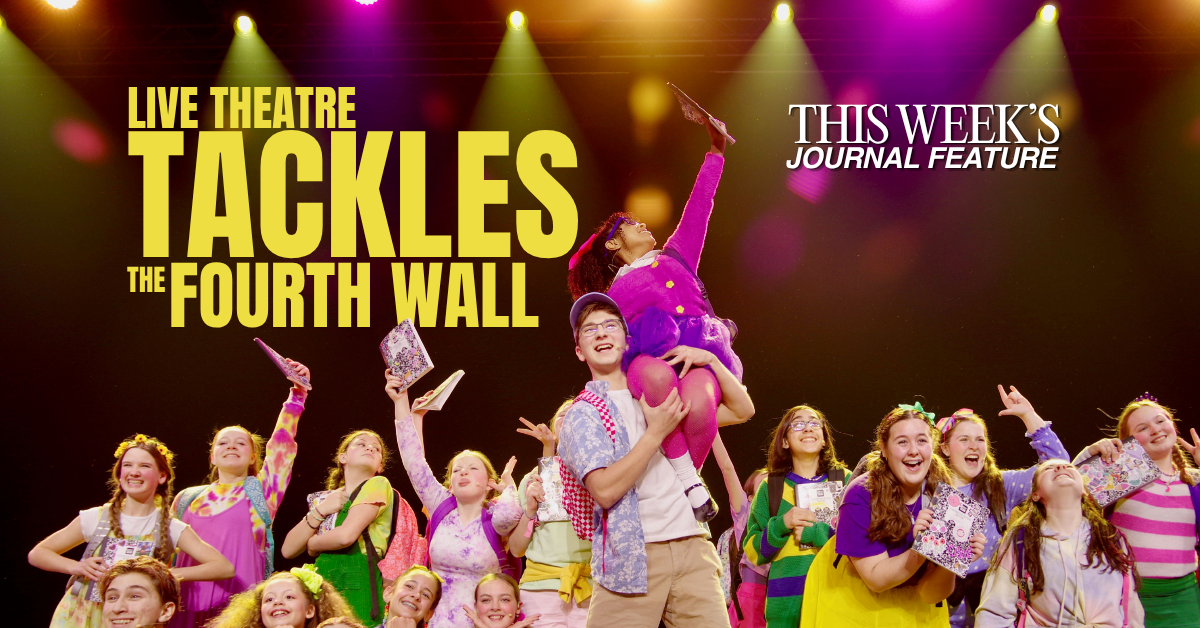
The worlds of live sports and media entertainment are fused so tightly that it’s difficult to distinguish a crack in the curtain. And now, in a convergence some audiences didn’t see coming, live musical theater has shot onto our screens like a pole vault or a pirouette.
It has made us sing “Defying Gravity” in a cinema packed with strangers who became our friend group for the runtime. We’re together. We’re fans. And it doesn’t matter if we don’t know all the words.
Today, theater is speaking straight to its audience through screens, both mobile and fixed.
Adrenaline dances with art
Georgia has been busting through the fourth wall, the imaginary barrier between actor and audience, for nearly a quarter of a century by hosting a powerhouse event that draws New York’s top talents south each year: the Junior Theater Festival, born in 2002.
Held annually at the 144,000-square-foot Cobb Galleria Centre, northwest of downtown Atlanta, the three-day JTF event fills the venue to capacity with young musical theater performers, including the rising stars of Broadway and the globe, along with their families and school teachers.
JTF is also held on the West Coast in Sacramento, California, and in Europe, Australia and New Zealand. It is reportedly the world’s largest gathering and celebration of young people who perform musical theater.
According to JTF Worldwide founder and CEO Timothy Allen McDonald, a musical theater director, producer, librettist and author based in New York, the stage-to-screen educational event he founded has served up-and-coming performers and cultivated an audience that might otherwise have never existed.
“For live theater, in particular, less than one percent of humans get to see a Broadway show,” McDonald says. “I create Broadway Junior shows that have a North American audience of 36 million. With that, we’re still only scratching 20 percent of the potential global viewers. So if you think about how you provide that access, you have to film it and broadcast it.”
In addition to the 2024 blockbuster theater-to-film adaptation of “Wicked” starring Ariana Grande and Cynthia Erivo, which snagged 10 Academy Award nominations in 2025, McDonald points to the earlier success of the Broadway musical “Hamilton,” which was live-streamed on Disney+ in July 2020 after a planned 2021 theatrical release fell through due to the coronavirus pandemic.
As Disney’s streaming and broadcast involvement in JTF shows, investment in youth theater signals the reach of the theater-to-film movement. Amazon sees the wisdom, too, and is collaborating with McDonald on distribution.
Aside from the business moves, what do students, tomorrow’s theater and film artists, gain? World-class education and a stage on which to break through. For each annual three-day event in Atlanta, JTF draws global student troupes who each perform a 15-minute show from a Broadway musical before a panel of judges made up of experts from around the world. The weekend includes workshops for students, teachers and parents and a grand finale concert headlined by Broadway’s best in the Galleria’s 25,000-square-foot ballroom. Event sponsors include Playbill, Music Theatre International and Disney Musicals.
It’s an opportunity students relish, and it’s a symbiotic relationship that also benefits the business side. At JTF in January 2025, more than 8,000 performers, creators, crew, supporters and enthusiasts attended, making metro Atlanta their home base for three to four days.
From the student-family-instructor attendees to the film and television crew members, manufacturer teams, contractors, electricians, visual artists and others who ate, drank and slept all things JTF preparation for weeks leading up to the event, then lingered long after for strike down, the Atlanta economy received an estimated $3.4 million boost.
That impact underscores how youth theater contributes to culture and to Georgia’s tourism and economic development, priorities state leaders are working to strengthen through policy.
Recognizing the potential of bringing live theater to the screen, Disney has served as a broadcast partner since 2005, supporting and capitalizing on JTF by producing and distributing coverage to viewers worldwide.
Of note, 2025 marked the first year JTF and Disney captured a world premiere Disney musical live on stage, then distributed it across Disney’s platforms, including Disney+, YouTube and Amazon Prime. Hosting JTF in Atlanta means Georgia itself becomes the launchpad for global creative distribution. The city also houses the newest phase of Junior Theater Festival Productions LLC, which is now a Georgia corporation, with its offices and stage sets warehoused in the ICP Production Centre on Boat Rock Boulevard, anchoring the event’s production right in the metro area.
What sports taught the theater pro
Even in the instance of JTF, sports converge with entertainment. Back when McDonald was learning the ropes of theater management in his first jobs in New York, he wanted to find a way to attract young people to theater and prepare them for professional careers. So he founded Broadway Junior, an organization devoted to helping young enthusiasts and schools produce and perform Broadway musicals adapted for young performers and their audiences.
“I had this concept, and I wanted to understand how Little League baseball and football became such strong programs in schools, why they’re in schools, and what the history was,” McDonald says.
What he learned was this: sports’ infiltration of schools was a purposeful way of cultivating and preparing top young talent to become professional athletes. “You have to teach kids how to start, and competition is good for that,” McDonald says. “Competition means the field for what you’re doing gets stronger. So I studied the Little League World Series concept and how it started, and I thought, what if we applied that to theater?”
In his work with Broadway Junior and during the early stages of JTF, McDonald applied the baseball and football training model to educational theater programs. “I pitched this competition for youth in theater idea to regional theaters, six different ones, and they all thought I was crazy except for Theater of the Stars,” McDonald says. That Georgia nonprofit company, once run by producer Christopher B. Manos, ran for 60 seasons. “And he said, I’m in. Let’s do it.”
In 2003, the first JTF took place at the Fox Theatre in Atlanta. Two years later, McDonald met with Tom Schumacher at Disney Theatrical with an idea. “You’ve got all these titles, all these IPs, just sitting on the shelves,” he told Schumacher. “Let me turn them into musicals for schools.” Schumacher said yes. “So in 2005, we introduced the world to the Disney collection. We started with Aladdin, and that was the magic key,” McDonald says.
By 2007, JTF had grown so popular with student troupes from around the world that the event moved to the Cobb Galleria Centre.
Instant replay
Today, the JTF event is broadcast live globally, far exceeding the 8,000 theater students, families and teachers who travel to Atlanta each year. “There is an entire world, a universe, that wants to be part of this,” McDonald says. “And so we live capture everything, and it’s broadcast all weekend long as a reality show, essentially. The show is a production set for a worldwide broadcast.”
In addition to drawing in attendees and viewers from around the globe, JTF at the Galleria in 2025 employed more than 500 Georgia residents, including film and television crew members, contractors, electricians, manufacturer teams and visual artists.
In keeping with the importance of all these roles, JTF also offers an in-depth theater tech track. The event highlights how Georgia’s workforce, infrastructure and incentive environment serve not just film and television but also live theater and convergent entertainment.
In the end, it all comes back to the student, whether of theater, television, entertainment, technology, marketing or business. And to their futures, where all fields are equally impacted in a convergence of media, community and possibility.
McDonald puts it in perspective: “These young people who attend JTF are going into the arts. They’re going into film and television, and for those who don’t, they are still going to have the skill set of understanding how to communicate, how to collaborate, and how to create something with other people. Something greater than what you could ever create by yourself.”
This article appeared in the 2026 edition of the Creative Economy Journal. See more from the Journal here.