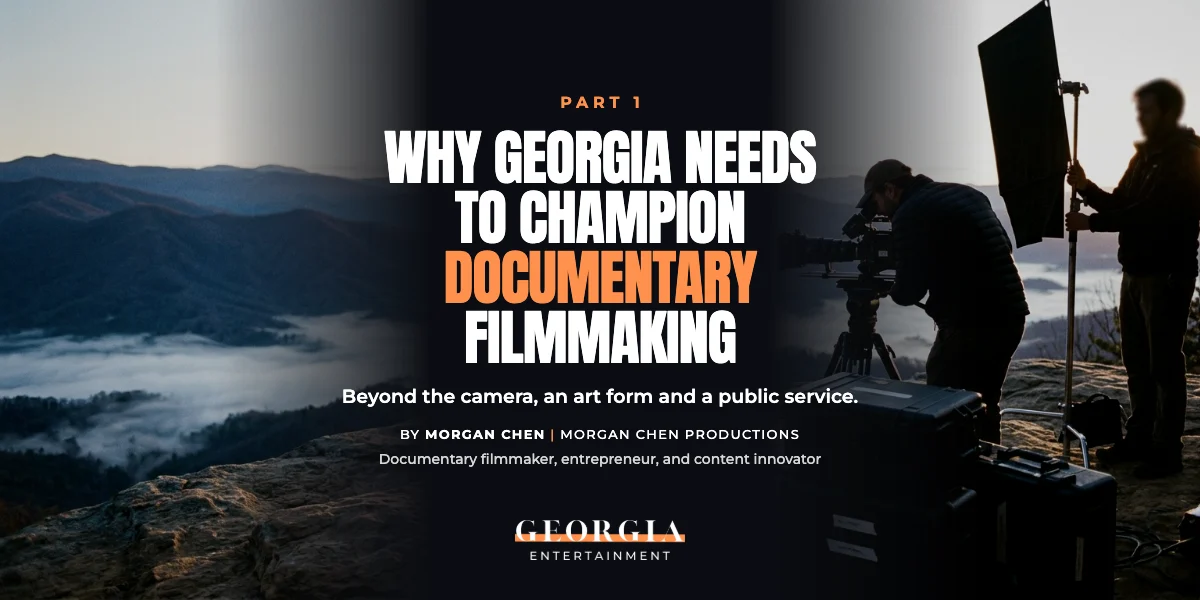
Beyond the camera: Why Georgia needs to champion documentary filmmaking | Part 1
Documentary filmmaking is an art form, a public service and a powerful way for communities to examine themselves. As the film industry evolves, Georgia has an opportunity to invest in the filmmakers who tell the stories that help us understand who we are.
By Morgan Chen
Editor’s note: This is Part 1 of a two-part series. Come back next week for Part 2, which looks at what Georgia can do to build a stronger documentary community.
Documentary filmmaking is an art form, a public service and a powerful way for communities to examine themselves. As the film industry evolves, Georgia has an opportunity to invest in the filmmakers who tell the stories that help us understand who we are.
There is something extraordinary about sitting in a dark theater, watching a film about someone whose life is completely different from your own, and suddenly recognizing something familiar. You see a struggle you have never experienced, a decision you have never had to make or a community you have never visited. Yet, somewhere in that story, something reaches you. You begin to understand another person’s circumstances and courage, reconsider your own assumptions and perhaps even see your own life differently.
That is the power of documentary filmmaking.
A documentary can take an ordinary person and place their extraordinary life in front of an audience. It can examine the mysteries of actual people in actual situations, expose underlying conflicts, investigate important questions and reveal experiences that might otherwise remain unseen. It can make the familiar unfamiliar, challenge comfortable assumptions and bring people into conversations they might never have entered on their own.
It is an art form that reaches beyond entertainment. It brushes against the heart, awakens curiosity and, at its best, inspires people to do something meaningful with what they have learned.
Documentary filmmaking is one of America’s quintessential art forms. It is deeply connected to the country’s tradition of individual expression, free inquiry, public debate and the belief that ordinary people can challenge powerful institutions. It is accessible enough that a filmmaker can begin with a smartphone, a compelling subject, an intelligent mind and the determination to investigate something important. Yet its artistic possibilities are as sophisticated as any form of cinema.
Most importantly, documentary filmmaking is a work of passion. It often begins because someone encounters a person, an injustice, a mystery or an experience that they cannot simply walk away from. They feel compelled to understand it, document it and share it with others.
Georgia should do more to encourage that impulse.
The documentary industry is changing, but the stories have not disappeared
The documentary industry is experiencing a difficult transition. Financing has become more challenging, traditional distribution pathways are less predictable, and streaming platforms have changed the economics of getting films in front of audiences.
The debate over whether documentary filmmaking has passed its so-called golden age has become increasingly common. But the evidence suggests a more complicated picture. Filmmakers, films and audiences all appear to be there. The harder problem may be connecting all three through a sustainable business model.
In September 2026, documentary producer Kathleen Lingo interviewed Thom Powers, the longtime documentary programmer for the Toronto International Film Festival. Powers said TIFF received about 900 feature-length documentary submissions in 2026, and he estimated the previous year’s total at about 850.
“The fact that it’s going upward instead of downward on the graph is striking,” Powers said.
Powers said his colleagues told him ticket sales were trending much higher than the previous year, which had also been up over the year before.
The challenge, he said, is making documentary filmmaking financially sustainable. Traditional sources of revenue, including theatrical ticket sales, video-on-demand rentals and licensing fees, no longer provide the same dependable opportunities for independent filmmakers. Distribution deals are taking longer, and a festival premiere no longer guarantees an immediate acquisition.
Powers offered an unconventional suggestion to aspiring documentary professionals: “Instead of considering making a film, consider how you might put your energy into starting a new distribution company.”
“I do think the audience is there. The films are definitely there,” he said.
His observation points to an important distinction. Alongside people who know how to make films, the documentary industry needs people who know how to connect those films with audiences, develop new distribution channels and build sustainable businesses around independent storytelling.
Documentary as a connector for society
I believe that one of the most important opportunities for documentary filmmaking is its ability to connect people who might otherwise never come together.
A documentary can bring filmmakers, actors, cinematographers, community members, business leaders, educators, students, policymakers and audiences into a shared experience. It can create a reason for people to gather, listen and examine the world around them.
This is also a potential answer to the audience problem.
Rather than relying entirely on an algorithm, a streaming platform or a film festival to discover an audience, filmmakers can build an invested community around the subject itself.
Imagine a documentary about workforce development. The film could bring together manufacturers, employees, educators, workforce organizations, elected officials and students. Each of those individuals has a personal or professional interest in the subject. They have a reason to participate, contribute, share the film and help bring others into the conversation.
A documentary about criminal justice reform can connect formerly incarcerated individuals, families, correctional professionals, rehabilitation organizations, attorneys, community leaders and policymakers.
A film about environmental change can bring together residents, scientists, businesses, conservationists and local government.
In each case, the documentary also becomes a gathering point for people who care about an issue and want to understand it better.
Filmmakers have an opportunity to develop partnerships well before a film is finished. Communities can help identify stories, provide access, support production, participate in screenings and contribute to impact campaigns.
That creates an invested audience with a stake in the subject. It also creates opportunities for sponsorship, educational licensing, institutional partnerships and community-supported distribution.
The Independent Television Service provides an example of what this approach can accomplish. ITVS reported 33.7 million streaming and broadcast views in 2025, alongside more than 20,000 participants in local screenings hosted by hundreds of organizations. Its reporting also found that 63% of surveyed screening participants planned to discuss issues explored in the documentaries.
Those results demonstrate something important: A documentary’s value does not end when the credits roll. The conversation that follows can be just as consequential.
The courage to look at uncomfortable things
A documentary filmmaker has to be willing to go where the story leads, including places that are uncomfortable, complicated and sometimes difficult to understand.
Life is not always fair, deserving or predictable. It is full of disappointments, hope, compromise, temptation, desperation and the slings and arrows of circumstance. People make decisions under pressure. They experience consequences. They struggle to prove themselves, rebuild their lives and find a reason to keep moving forward.
But courage still exists. Generosity still exists. Forgiveness still exists.
There are remarkable individuals living extraordinary lives all around us. Some are overcoming circumstances that would be difficult for most people to imagine. Others are quietly working to improve their neighborhoods, support their families, build businesses, protect their communities or help someone else find a better future.
These are stories worth telling.
Helen Keller once wrote:
“Although the world is full of suffering, it is full also of the overcoming of it.”
That sentiment captures something important about documentary filmmaking. Exposing suffering and identifying problems is only part of the work. A documentary should also examine the people who confront those problems, the decisions they make and the possibilities they create.
The filmmaker’s responsibility is to investigate honestly, approach people with empathy and allow the complexity of their experiences to emerge, without manufacturing a happy ending or forcing a moral conclusion.
Beyond an important subject, a compelling documentary needs a good story, engaging characters, narrative tension and an integrated point of view. It must explore causes and effects, reveal conflicts and give audiences a reason to care about what happens next.
The strongest documentaries reflect the richness and ambiguity of life. They go beyond detached observation to include impressions, perceptions and feelings while remaining disciplined about evidence and truth.
There is an artistic and ethical responsibility in that work. A filmmaker must recognize that the people being documented are individuals with complicated lives, relationships, histories and futures.
The quality and justice of human life are what lift documentary beyond the realm of ordinary content and into moral and ethical dimensions.
Georgia Insider is NOW OPEN
Georgia Insider is a private community for the executives, founders, creators and leaders shaping Georgia’s creative and innovation economy. Subscribers receive Insiders PLUS, access to community conversations, event opportunities and original content, with deeper access available through Executive Membership.
Start your journey today.
Staying Connected with Georgia Entertainment
Follow us on LinkedIn or Instagram. Subscribe to our newsletter.
Are you available to speak on panels, share at our events or contribute thought leadership via commentary or perspective? Contact us with your thoughts and ideas.
Indie Spotlight Signup
Sign up for our monthly newsletter highlighting independent creators based in Georgia.