Delaney Tarr
Staff Writer
Immersive entertainment is one of the fastest-growing sectors of the global creative economy, and Georgia is becoming a key part of that story. Just as film incentives helped make the state a production powerhouse, the same creative talent and infrastructure are fueling a new wave of experiences that blend technology, storytelling and interactivity.
For communities across Georgia, immersive attractions are not only cultural highlights but also drivers of tourism, jobs and economic growth.
Entering the new world
Imagine stepping inside your favorite painting, joining the troupe of your favorite show, or learning about history with all of your senses. It may seem far-fetched, but immersive entertainment is bringing art to the audience—and the audience inside the art. Immersion is the word taking over the entertainment industry, with hugely popular installations like Meow Wolf and the Sphere concert venue in Las Vegas.
Now it’s arrived in Georgia, and crowds are diving into the new creative landscape. But what exactly is immersive entertainment? It’s a broad category. The Sphere is a concert venue, but it’s considered immersive for its enveloping 360-degree screens. Haunted house attractions with roaming performers are immersive too. Every creative defines it differently.
“True immersion is when the audience has a role that can define their experience differently each time, and they’re getting some kind of emotional gift from being highly present,” said Kelly Nelson, co-founder and chief creative officer of Mirth & Mischief.
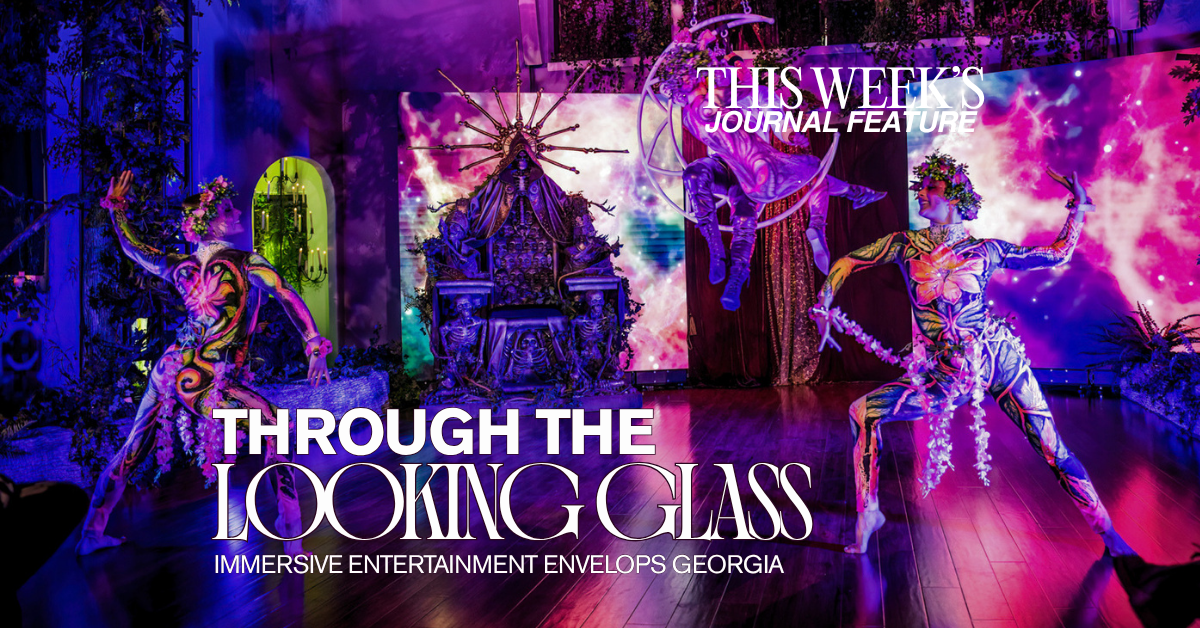
Nelson runs the immersive theater experience Mirth & Mischief, a mix of virtual reality, aerial performances, puppetry and interactive storytelling that began at a castle in Helen, Georgia.
Its first venue, Uhuburg Castle, was tucked inside the Bavarian-style mountain town. Soon it will pop up in other locations across the state. No matter the location, each iteration promises the same thing: a total transformation and immersive wonderland for every person who joins the story.
Nelson, a Georgia native and longtime creative, noticed something was missing for modern audiences with shrinking attention spans and access to a vast variety of entertainment: being part of the story. That’s where her expansive and eccentric production began. She brought puppeteer Steve Whitmire, known for his decades of work on “The Muppets” and “Sesame Street,” to create puppets such as a massive dragon, which in the Mirth & Mischief show represents suppressed anger.
Every performer, down to the front-of-house staff, became a character in the piece, with dozens of literary and pop culture easter eggs hidden throughout the night. The result was a mesmerizing experience in a castle that explored mental illness, healing through community and fantastical tales where guests could wander freely. No two nights were the same.
“We had so many people unzipping emotionally,” Nelson said. During the run of Mirth & Mischief, attendees came from 24 states and six countries to journey through the castle gates and into something entirely new. They saw puppetry, dance, circus arts, live music, acrobatics, character acting, virtual reality and video projection mapping all in the service of the story.
At Mirth & Mischief, the environment rewards curiosity. “I had to adjust for audiences who had no idea what this was,” Nelson said.
Time and again, she saw crowds embrace a new way of experiencing art. One night, a few guests told her the musicians were trapped and needed help. Nelson panicked until she realized the guests had joined an impromptu side quest with the performers. It’s the ever-changing element the creative director loves about her immersive experience.
“It’s all about the audience making decisions that change their experience,” Nelson said.
A feast for the senses
Not every immersive experience is quite so involved. For those easing into immersion, there are plenty of options. The traveling immersive Van Gogh Exhibition by Lighthouse Immersive drew massive crowds in Atlanta, blending more than 400 projected paintings with music and optional virtual reality. It sold millions of tickets nationwide, showing how immersive installations drive tourism and destination appeal.
The Savannah College of Art and Design also leaned into immersion with SCADstory, a 20-minute 4D journey through its history and vision. Partnering with BRC Imagination Arts, SCAD created an experience that combines projection mapping, scent and interactive sets to tell the story of Paula Wallace’s founding vision. It’s another example of Georgia institutions using immersive tools to build cultural and economic capital.
An immersive future
Creatives like Nelson see vast potential ahead. Empty fields, soundstages or even sports venues can transform into new immersive canvases. With Georgia’s film infrastructure already in place, these spaces are primed for innovation that extends beyond film into sports, live entertainment and tourism experiences.
“Something has shifted in the South,” Nelson said. “The timing is right, and the support is there.” Immersive entertainment is more than a trend. It’s part of Georgia’s evolution into a global creative hub. By connecting art, technology, tourism and policy, these experiences embody the convergence of entertainment and innovation.
And just as the film incentive once redefined the state’s role in global storytelling, immersive experiences now signal the next frontier for Georgia’s creative economy.
This article appeared in the 2026 edition of the Creative Economy Journal. See more from the Journal here.